Rolling stock
Best Metal Wheelsets
Quick answer
The best metal wheelset for most HO freight cars is the Walthers Proto 33 inch Metal Wheelset at $19.99. Metal wheels roll further and shed almost none of the plastic debris that plastic wheels grind onto the railhead, making this the highest-value cheap upgrade in the hobby.
If there is one upgrade worth making before any other purchase in this hobby, it is replacing the plastic wheels a car ships with for metal ones. Plastic wheels are a major, and widely underestimated, source of the fine black gunk that collects on rail and gets blamed on dirty track or old rail. Metal wheels are turned rather than molded, so they run truer, roll further on a coast test, and do not grind plastic dust onto the railhead the way plastic wheels do. The Walthers Proto 33 inch Wheelset and the Kadee 33 inch Metal Wheels are both correctly sized for standard HO freight trucks.
Diameter matters and getting it wrong is a visible error, not a rounding difference. 33 inch wheels are the standard size for most HO freight cars. 36 inch wheels are heavier and represent more modern equipment, and fitting a 36 inch wheel where a 33 inch wheel belongs is the kind of mistake an experienced modeler notices immediately. Check the car's original wheel diameter before ordering a replacement.
On this page
- Why do metal wheels matter more than which car I buy?
- What is the difference between 33 inch and 36 inch wheels?
- Does a metal wheelset upgrade change how a car electrically picks up power?
- Best cheap first metal wheelset upgrade
- Best metal wheelset for ongoing fleet upgrades
- Best bulk metal wheelset for a full roster conversion
Why do metal wheels matter more than which car I buy?
A freight car's wheels touch the rail on every inch of every run, and a plastic wheel that is slightly out of round or carries mold flash on its tread introduces a small amount of resistance and vibration on every rotation. Multiply that by thousands of rotations per session and it adds up to rougher running, more frequent derailments, and a fine plastic residue ground onto the rail that many modelers mistake for ordinary dirt. Swapping to metal wheels is often a bigger improvement in how a layout runs than buying another locomotive, and it costs a fraction as much. See the full comparison at metal vs plastic wheelsets.
What is the difference between 33 inch and 36 inch wheels?
33 inch wheels are the standard diameter fitted to most HO freight cars, from boxcars to hoppers to gondolas. 36 inch wheels are used on heavier and more modern freight equipment, and they sit visibly larger in a truck built for the smaller size. Fitting the wrong diameter is not a rounding error, it is a visible mismatch that stands out to anyone who knows what a correctly sized wheel looks like. Check the car's original equipment before ordering a replacement, and when in doubt, 33 inch is the safer default for a typical mixed freight car roster built before checking each prototype individually.
Diameter and pack size are the two variables that matter when choosing a wheelset. A car has two trucks, and each truck holds two wheelsets, so a full car conversion needs four wheelsets.
The bulk 100 pack is priced for a fleet conversion, not a single car, and buying it for three cars wastes most of the pack.
| Wheelset | Price | Diameter | Best for |
|---|---|---|---|
| Kadee HO Metal Wheels 33 inch Smooth 12 Pack | $16.39 | 33 in | A cheap first upgrade, 12 pack |
| Walthers Proto HO Scale 33 inch Wheelsets Metal Wheels and Metal Axles 12-Pack | $19.99 | 33 in | Precision turned axles, standard freight |
| Walthers Proto HO Scale 36 inch Wheelsets Metal Wheels and Metal Axles 12-Pack | $18.49 | 36 in | Heavier, more modern equipment |
| Walthers Proto HO Scale 36 inch Turned Metal Wheelsets With Metal Axles 100-Pack | $94.72 | 36 in | Bulk fleet conversion, 25 cars worth |
One car needs four wheelsets, two per truck. A 12 pack converts three cars, a 100 pack converts twenty-five.
Does a metal wheelset upgrade change how a car electrically picks up power?
On a DC layout, metal wheels make no functional difference to power pickup, since the locomotive is the only thing that needs to draw current and freight cars typically do not. On a DCC layout wired for signal-triggered lighting, sound cars, or occupancy detection, metal wheels can matter a great deal, because some detection circuits and lighted car designs rely on the axle and wheel assembly to complete a low-current circuit through the rails. A car with plastic wheels on an axle designed for that kind of detection simply will not trigger it, which looks like a wiring fault until the wheel material is checked. This is a niche case for most modelers running plain freight and passenger equipment, but it is worth knowing before assuming a detection circuit is broken when the real cause is a wheel material mismatch on one specific car.
Swapping the wheelset itself is a simple mechanical job on most trucks: the truck sideframe pops open or the wheelset presses out of its bearing points with light finger pressure or a small tool, the new metal wheelset presses back in the same way, and the truck is checked for free rolling before the car goes back on the rails. No soldering and no gluing is involved, which is part of why this upgrade has such a good return on the small amount of time it takes compared with almost anything else on a workbench.
Best cheap first metal wheelset upgrade
Convert one or two cars first to feel the difference on a coast test before committing to the whole fleet.

Kadee HO Metal Wheels 33 inch Smooth 12 Pack
$16.39A 12 pack of standard 33 inch metal wheels, enough to convert about three cars and see the improvement firsthand.
Best for: A first metal wheel upgrade on a small fleet
Check price on AmazonBest metal wheelset for ongoing fleet upgrades
Precision turned metal wheels and axles are the buy-once version of the same upgrade, sized for converting cars as the fleet grows.

Walthers Proto HO Scale 33 inch Wheelsets Metal Wheels and Metal Axles 12-Pack
$19.99Turned metal wheels and axles in the standard 33 inch diameter, priced for ongoing conversions rather than a one-time trial pack.
Best for: Converting cars steadily as the roster grows
Check price on AmazonBest bulk metal wheelset for a full roster conversion
Once a fleet reaches dozens of cars, a bulk pack is the only way the per-wheelset cost makes sense.
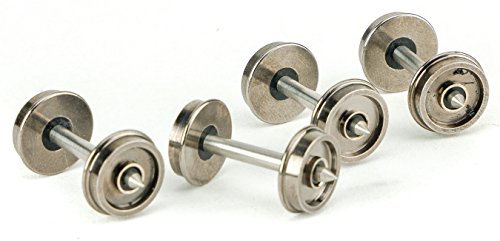
Walthers Proto HO Scale 36 inch Turned Metal Wheelsets With Metal Axles 100-Pack
$94.72 Specs and fitmentA 100 count bulk pack of 36 inch turned metal wheelsets, priced for converting a large roster of heavier, more modern freight cars in one order.
Best for: A fleet of twenty or more cars needing the 36 inch diameter
Check price on AmazonWho should not buy this tier: Skip the bulk 36 inch pack if the fleet is mostly standard freight cars that take 33 inch wheels, or if the fleet is under ten cars. Fitting 36 inch wheels where 33 inch belongs is a visible, avoidable mistake.
How we chose
We did not test these products in person and we never claim to. Picks are researched from manufacturer specification sheets and instruction manuals, published NMRA standards and recommended practices, and the recurring themes in verified owner reviews. Every pick is matched to a real scale, a real minimum radius or a real current draw rather than to a price bracket, and it is placed in the tier where its capability actually belongs. Where a product is wrong for most layouts we say so on the page, and where a figure is a hobby rule of thumb rather than a published standard we say that too.
Sources
- NMRA standards for wheel and gauge dimensions
- Walthers and Kadee published product specifications
Frequently asked questions
Are metal wheels really worth the upgrade over plastic wheels?
Yes, for most modelers this is the highest-value cheap upgrade available. Metal wheels are turned rather than molded, so they roll truer and further on a coast test, and they do not shed the fine plastic residue that plastic wheels grind onto the rail over time, which is often mistaken for simple dirty track.
What is the difference between 33 inch and 36 inch wheels?
33 inch is the standard diameter for most HO freight cars, while 36 inch wheels are used on heavier and more modern equipment. Fitting the wrong diameter is a visible mismatch, not a minor error, so check the car original equipment before ordering a replacement rather than assuming one size fits every car.
How many metal wheelsets does one freight car need?
Four. Each car has two trucks, and each truck holds two wheelsets, so a full conversion of one car uses four wheelsets. A 12 count pack converts about three cars, and a 100 count bulk pack converts about twenty-five cars, which matters when comparing the price per pack.
Do metal wheels fix black residue on model railroad track?
They often do, since plastic wheels grinding against the railhead are a major and underestimated source of the fine black film that many modelers blame entirely on dirty rail or oxidation. Converting the fleet to metal wheels, alongside regular track cleaning, addresses a cause of the residue rather than only the symptom.
Can metal wheels cause an electrical short on a layout?
A metal wheel and axle assembly can bridge the two rails electrically if it is not properly insulated on one side, the same as any conductive axle. Quality metal wheelsets from established manufacturers are built with correct insulation for standard DC and DCC wiring, so a short from a properly installed wheelset is uncommon.
Should I upgrade wheels or buy new cars first?
Upgrade the wheels on the cars already on the roster before buying new cars to fix a running problem. Metal wheels are a fraction of the cost of a new car and very often solve the derailment or residue problem a modeler assumed needed a different car or cleaner track to fix.
Researched, not professional advice. This page is compiled from published manufacturer specifications, instruction manuals, published NMRA standards and recommended practices, and owner-review consensus, not hands-on testing. Figures described as a rule of thumb are hobby convention rather than a standard, and they are labelled that way wherever they appear. Always check a radius, a clearance or a grade against your own equipment before you cut wood or lay rail, because manufacturers vary and so does what your specific models will tolerate. Any permanent mains wiring in a layout room is work for a licensed electrician to your local code.