DCC control
Best N Scale DCC Decoders
Quick answer
The best DCC decoder for most N scale locomotives is the Digitrax DZ126IN 1 Amp Decoder with 6-Pin NEM651 Plug at $34.41, because its 6-pin NEM651 plug matches the decoder socket built into most modern N scale locomotives, turning the upgrade into a plug-in installation instead of a soldering job inside one of the smallest shells in the hobby.
N scale decoder installation is a tighter job than HO in every sense, literally. Locomotive shells leave little room to work, and the decoder itself has to be small enough to fit. The Digitrax DZ126IN 1 Amp Decoder with 6-Pin NEM651 Plug solves the fit problem with a plug that matches the common 6-pin NEM651 socket, so the actual installation is connecting a plug rather than routing wires inside a shell the size of a fingertip.
Sound is where N scale asks for an honest trade-off. The ESU LokSound 5 Micro Direct Generic Sound Decoder N Scale is a real sound decoder built specifically for N scale, but the speaker that fits inside an N scale shell is a small fraction of the size of an HO sugar cube speaker. It produces genuine, recognizable diesel or steam sound, and it is noticeably thinner and quieter than the same sound decoder line in HO. That is a physical limit of the scale, not a flaw in one product.
On this page
- Plug-in or wired decoder for an N scale locomotive?
- N scale decoder comparison
- Best first N scale decoder
- Best decoder for an N scale locomotive with no plug
- Best N scale sound decoder, with the honest limits stated
- Does N scale decoder installation need different tools than HO?
- What is a realistic budget for converting an N scale fleet to DCC?
Plug-in or wired decoder for an N scale locomotive?
Check the locomotive for a decoder socket before choosing. The Digitrax DZ126IN 1 Amp Decoder with 6-Pin NEM651 Plug uses the 6-pin NEM651 plug found in most current N scale locomotives with a decoder socket already built in. The Digitrax DZ126 1 Amp Z, N and HO Scale Wired Mobile Decoder is the wired version of essentially the same decoder, for a locomotive with no socket, or for a modeler who prefers to route the decoder's wires to a specific location inside a particularly cramped shell rather than relying on the plug's fixed position.
N scale decoder comparison
Sound decoders cost roughly three to four times a basic function-only N scale decoder, and the honest reason is the speaker, not the electronics.
The two Digitrax function-only decoders cost under 35 dollars each, while the LokSound 5 Micro sound decoder costs roughly four times as much for a sound decoder built into an N-scale-sized shell.
| Decoder | Price | Interface | Sound | Best for |
|---|---|---|---|---|
| Digitrax DZ126IN 1 Amp Decoder with 6-Pin NEM651 Plug | $34.41 | 6-pin NEM651 plug | No | Plug-in install on a modern N locomotive |
| Digitrax DZ126 1 Amp Z, N and HO Scale Wired Mobile Decoder | $30.73 | Wired | No | A locomotive with no decoder socket |
| SoundTraxx ECO-PNP HO and N DCC Sound Decoder Diesel 1A | $67.96 | Plug and play, HO and N | Yes | Budget sound in N scale diesel |
| ESU LokSound 5 Micro Direct Generic Sound Decoder N Scale | $120.59 | N scale direct fit | Yes | The fullest sound available at N scale |
Best first N scale decoder
A function-only plug-in decoder is the easiest first N scale DCC upgrade, with no soldering and no speaker to fit inside an already tight shell.

Digitrax DZ126IN 1 Amp Decoder with 6-Pin NEM651 Plug
$34.41A plug-in installation on the common 6-pin socket, with no soldering required.
Best for: The easiest first DCC conversion in N scale
Check price on AmazonBest decoder for an N scale locomotive with no plug
Older or budget N scale locomotives frequently have no decoder socket at all, which calls for the wired version of the same decoder.
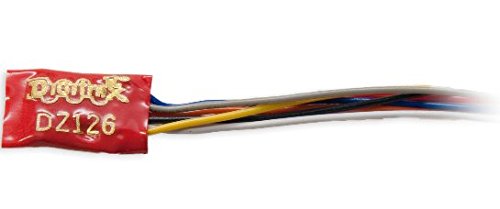
Digitrax DZ126 1 Amp Z, N and HO Scale Wired Mobile Decoder
$30.73The same 1 amp decoder as the plug-in version, wired for a locomotive with no decoder socket.
Best for: A locomotive without a decoder socket built in
Check price on AmazonBest N scale sound decoder, with the honest limits stated
Sound in N scale is real and worth having if the priority is DCC operation with sound, not a room-filling audio experience.

ESU LokSound 5 Micro Direct Generic Sound Decoder N Scale
$120.59The fullest sound decoder built specifically for N scale, within the physical limit of a speaker this small.
Best for: A modeler who wants sound in N scale and accepts a thinner, quieter result than HO
Check price on AmazonWho should not buy this tier: Skip this if you are expecting HO-scale volume and depth. The speaker that fits an N scale shell is a small fraction of the size of an HO sugar cube speaker, and no decoder brand changes that physical limit. If room-filling sound is the priority, that is a reason to build in HO instead of N, not a reason to avoid N scale sound entirely.
Does N scale decoder installation need different tools than HO?
The tools are the same, but the tolerance for error is smaller. A soldering iron for a hardwire install needs a fine tip and a lower wattage setting than a typical HO job, since the wires and pads involved in an N scale locomotive are correspondingly smaller and more easily damaged by excess heat. A good pair of tools, like the HARDELL Digital Caliper 6 Inch with Large LCD for checking clearances and a fine flush cutter for trimming leads, matters more in N scale simply because there is less margin for a slightly oversized connection or a wire routed carelessly inside a shell this small.
Magnification is the one addition worth making for N scale work that most HO installations do not need. A basic head-mounted magnifier or a magnifying lamp makes the difference between confidently identifying a 6-pin socket's orientation and guessing at it, and a wrongly oriented plug connection is a common, entirely avoidable cause of a decoder appearing dead on first power-up.
Work over a light-colored tray or a piece of white cloth rather than directly on a dark workbench. An N scale decoder, its wires, and the small screws that hold an N scale shell together are easy to lose against a cluttered or dark surface, and a dropped decoder on carpet is genuinely difficult to find again given how small it is.
What is a realistic budget for converting an N scale fleet to DCC?
Budget roughly 30 to 35 dollars per locomotive for a basic function-only plug-in decoder like the Digitrax DZ126IN 1 Amp Decoder with 6-Pin NEM651 Plug, closer to 120 dollars per locomotive for sound using the ESU LokSound 5 Micro Direct Generic Sound Decoder N Scale. A mixed fleet, where only the locomotives that lead a train or run most often get sound and the rest get basic function decoders, is a reasonable and common way to control the total cost of converting an existing N scale roster rather than treating every locomotive as a sound candidate. Convert the fleet gradually, a few locomotives per year if needed, rather than all at once.
How we chose
We did not test these products in person and we never claim to. Picks are researched from manufacturer specification sheets and instruction manuals, published NMRA standards and recommended practices, and the recurring themes in verified owner reviews. Every pick is matched to a real scale, a real minimum radius or a real current draw rather than to a price bracket, and it is placed in the tier where its capability actually belongs. Where a product is wrong for most layouts we say so on the page, and where a figure is a hobby rule of thumb rather than a published standard we say that too.
Sources
- Digitrax and ESU published specifications
- NMRA decoder interface standards for N scale
Frequently asked questions
Why is N scale sound quieter than HO scale sound?
The speaker that physically fits inside an N scale locomotive shell is a fraction of the size of the sugar cube speaker used in HO sound decoders. Smaller speakers produce less volume and less bass response, so N scale sound is consistently thinner and quieter than the same decoder line built for HO, regardless of brand.
What decoder plug do most N scale locomotives use?
Most current N scale locomotives with a decoder socket use the 6-pin NEM651 standard, smaller than the 8-pin NEM652 plug common in HO. Always check the locomotive's actual socket before ordering, since some older or larger N scale models use different interfaces or no socket at all.
Is it harder to install a decoder in N scale than HO?
Physically yes, simply because there is less room inside the shell to work, route wires or fit a speaker. A plug-in decoder that matches the locomotive's existing socket removes most of that difficulty, since the installation becomes connecting a small plug rather than soldering inside a cramped space.
Can I put an HO sound decoder in an N scale locomotive?
No. HO sound decoders and their speakers are too large to fit inside an N scale shell. N scale requires decoders and speakers specifically sized and built for the scale, like the LokSound 5 Micro, which is why N scale sound decoders cost more relative to their function-only counterparts than the difference in HO.
Do N scale decoders need a different DCC system than HO?
No, N scale and HO scale decoders both follow the same NMRA DCC standard and run on the same command station, whether Digitrax, NCE or ESU. The decoder itself is sized differently to fit the smaller locomotive, but the system controlling it does not need to change between scales.
Is a wired or plug-in decoder better for N scale?
A plug-in decoder is easier and faster to install if the locomotive already has a matching socket, since no soldering is required. A wired decoder is necessary for a locomotive with no socket at all, and some modelers prefer it even with a socket present, for more control over where the decoder physically sits inside a tight shell.
Researched, not professional advice. This page is compiled from published manufacturer specifications, instruction manuals, published NMRA standards and recommended practices, and owner-review consensus, not hands-on testing. Figures described as a rule of thumb are hobby convention rather than a standard, and they are labelled that way wherever they appear. Always check a radius, a clearance or a grade against your own equipment before you cut wood or lay rail, because manufacturers vary and so does what your specific models will tolerate. Any permanent mains wiring in a layout room is work for a licensed electrician to your local code.