Rolling stock and shop
Ballast and Scenery Volume Calculator
Quick answer
Ballast volume is the cross section of the ballast profile times the track length. Ten feet of HO track takes about 8.4 cubic inches of ballast, a little over half a cup. A shaker of roughly 50 cubic inches covers about 60 feet of HO track.
Ballast is what makes track look like railroad rather than like track sitting on a board, and it is the step most people under-buy for. The volume is small in absolute terms and easy to underestimate, because the ballast profile is a thin trapezoid and nobody has an intuition for the volume of a thin trapezoid a hundred feet long.
The profile scales, so the calculation is done from prototype ballast dimensions divided by the scale proportion. That also means the grade of the ballast matters and using the wrong one is instantly obvious: fine for N, medium for HO, coarse for O. Coarse ballast in HO reads as boulders, and it is one of the most common visual mistakes in the hobby.
This calculator gives a volume, not a bag count, deliberately. Bag and shaker volumes differ by brand and product, and a bag count that is wrong by a factor of two is worse than a volume you can check against the label.
Ballast and scenery calculator
Ballast volume
Ballast and scenery materials
Top matches update when you change your numbers.
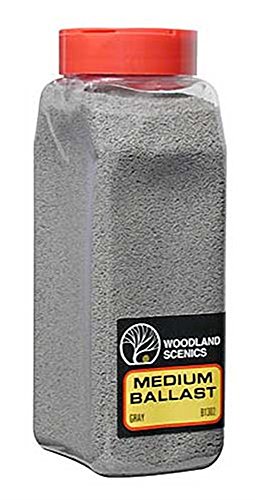
Woodland Scenics Medium Ballast Shaker Gray 50 cubic inches
$19.90Medium grade, the correct size for HO scale mainline track. This is the default for most modellers.
Best for: HO scale main line
Check price on Amazon
Woodland Scenics Fine Ballast Shaker Gray Blend 57.7 cubic inches
$19.40A blend of tones rather than one flat colour, which reads far better under layout lighting than a single grey does. The larger shaker holds more for a slightly higher price.
Best for: ballast that does not look uniformly grey
Check price on Amazon
Woodland Scenics B89 Coarse Ballast Bag Gray 18 cubic inches
$11.78Coarse grade for O and larger scales. In HO it reads as boulders, which is the most common ballast mistake there is.
Best for: O scale and larger
Check price on Amazon
Woodland Scenics Scenic Cement 16 oz
$14.26The adhesive that fixes ballast and ground cover in place. It soaks in and dries matt rather than shiny, which diluted white glue does not reliably do.
Best for: fixing ballast and ground cover
Check price on Amazon
Woodland Scenics Plaster Cloth Roll 8 by 180 inches 2 Pack
$33.80Two large rolls, which is a realistic quantity once you know how much a layout swallows. Scenery always takes more shell material than the first estimate.
Best for: covering a whole layout
Check price on Amazon
Woodland Scenics Undercoat 8 oz Earth
$14.34Paints the plaster shell an earth colour before any ground cover goes on, so the gaps that inevitably appear read as soil rather than as white plaster.
Best for: sealing and colouring the scenery shell
Check price on AmazonBallast profile and volume by scale
The ballast profile scaled from prototype dimensions, with the volume for ten feet of track. The top width is the ballast between and just outside the ties; the base is the foot of the shoulder.
Ten feet of HO track takes about 8.4 cubic inches of ballast, which is a little over half a cup, spread over a profile 2.48 inches wide at the base.
| Scale | Top width | Base width | Depth | Volume for 10 ft | In cups |
|---|---|---|---|---|---|
| N | 1.35 in | 1.95 in | 0.12 in | 23.8 cu in | 1.65 cups |
| HO | 2.48 in | 3.58 in | 0.22 in | 80.2 cu in | 5.55 cups |
| O | 4.5 in | 6.5 in | 0.4 in | 264 cu in | 18.29 cups |
Scaled from a prototype ballast section 18 feet across the top, 26 feet at the base and about 1.6 feet deep. Your own profile will differ, and a shallower shoulder uses noticeably less.
How much HO ballast will a layout need?
Volume by total track length in HO scale. Measure the track you actually have rather than the table size, because sidings and yards add up fast.
A 50 foot HO layout needs about 42 cubic inches of ballast, which is roughly one standard shaker.
| Track length | Volume | In cups |
|---|---|---|
| 10 ft | 80.2 cu in | 5.55 cups |
| 20 ft | 160.4 cu in | 11.11 cups |
| 30 ft | 240.5 cu in | 16.66 cups |
| 50 ft | 400.9 cu in | 27.77 cups |
| 75 ft | 601.3 cu in | 41.65 cups |
| 100 ft | 801.8 cu in | 55.53 cups |
Buy more than the calculation suggests. Ballast is spilled, over-applied on the first few feet while you find the technique, and discontinued in the exact shade you chose more often than you would like.
Getting ballast to stay where you put it
The technique matters more than the quantity, and it goes wrong in predictable ways.
Spread the ballast dry first and shape it with a soft brush, getting it off the tops of the ties and out of the points of any turnout. Ballast glued into a turnout mechanism ruins the turnout, and this is the single most expensive mistake available at this stage. Many people simply do not ballast the moving parts at all, which is invisible from normal viewing distance and entirely sensible.
Then wet it before applying adhesive. A drop of washing up liquid in the water, or an alcohol mist, breaks the surface tension so the glue flows in instead of beading up and dragging the ballast into clumps. Skipping this step is why a first attempt often ends up looking like gravel glued to a plank.
Then apply diluted adhesive with a pipette or syringe, letting it soak in rather than squirting it. Scenic cement dries matt; white glue diluted about one to four with a drop of detergent works and can dry with a slight sheen.
The scenery shell above it
Plaster cloth over a support web is still the fastest route from bare benchwork to something that reads as landscape. The area needed is more than the flat footprint, because terrain has slopes and slopes are longer than their plan view.
The terrain factor in this calculator defaults to 1.3, meaning gently rolling ground takes about 30 percent more cloth than the flat area. Genuinely mountainous scenery can take 60 percent more or worse, and a flat industrial scene takes almost exactly the footprint.
The practical advice: buy more than the calculation says. Scenery always takes more shell material than the first estimate, and running out halfway through a hillside means a visible join where the second batch starts.
Frequently asked questions
How much ballast do I need for my layout?
About 8.4 cubic inches per ten feet of HO track, so a 50 foot layout needs roughly 42 cubic inches, which is around one standard shaker. N scale needs about a third of that for the same length and O scale around three times. Buy more than the calculation suggests, because spillage and over-application on the first few feet are guaranteed.
What grade of ballast should I use?
Fine for N scale, medium for HO and coarse for O and larger. Using the wrong grade is one of the most visible mistakes in the hobby: coarse ballast under HO track reads as boulders and undermines everything else you have done. Some modellers prefer fine even in HO for a slightly more refined look.
How do I stop ballast beading up when I glue it?
Wet it first with water containing a drop of washing up liquid, or mist it with isopropyl alcohol. That breaks the surface tension so the adhesive flows in and soaks down rather than beading on the surface and dragging the ballast into clumps. Skipping this is why a first attempt often looks like gravel glued to a plank.
Should I ballast my turnouts?
Not the moving parts. Adhesive in the throwbar or between the point rails will jam a turnout, and cleaning set glue out of the mechanism usually costs more than the turnout is worth. Ballast the approaches and leave the points themselves alone, or mask them. Nobody notices at normal viewing distance.
What glue should I use for ballast?
Scenic cement made for the purpose soaks in and dries matt. Diluted white glue, roughly one part glue to four parts water with a drop of detergent, works and costs less, though it can dry with a slight sheen. Apply it with a pipette or syringe and let it soak in rather than squirting it, which displaces the ballast.
How much plaster cloth does scenery take?
Around 30 percent more than the flat footprint for gently rolling terrain, because slopes are longer than their plan view. Mountainous scenery can take 60 percent more. Buy extra: running out halfway through a hillside leaves a visible join where the second batch starts, and scenery consistently takes more than the first estimate.
Researched, not professional advice. This page is compiled from published manufacturer specifications, instruction manuals, published NMRA standards and recommended practices, and owner-review consensus, not hands-on testing. Figures described as a rule of thumb are hobby convention rather than a standard, and they are labelled that way wherever they appear. Always check a radius, a clearance or a grade against your own equipment before you cut wood or lay rail, because manufacturers vary and so does what your specific models will tolerate. Any permanent mains wiring in a layout room is work for a licensed electrician to your local code.