Track geometry
Curve Easement Calculator
Quick answer
An easement is a short transition of gradually tightening radius at each end of a curve. Its length is roughly three times your longest car, and the main curve shifts inward by L squared over 24R. For a 50 foot HO car into a 24 inch radius that is a 20.7 inch easement and a 0.74 inch offset.
A curve without an easement changes from dead straight to fully curved at a single joint. A car crossing that joint is jerked sideways, the couplers swing to their new angle instantly, and on a long train the effect propagates as a visible snatch. It is also a common cause of the derailment that only happens at one spot, in one direction, with one particular car.
An easement fixes it with a short transition whose radius tightens gradually from infinite to the curve's actual radius. The classic model railroad method is the bent stick: spring a thin flexible strip between the straight track and the curve and let the material find its own shape, which is very close to the correct spiral.
The geometric consequence is that the main curve has to move. Because the transition takes up space, the constant-radius portion shifts inward by an offset of L squared divided by 24R. That offset is small, usually well under an inch, and it is the number you need when marking out the curve.
Curve easement calculator
Easement length
Flex track and tools for laying easements
Top matches update when you change your numbers.

Atlas 500 36 inch Code 83 Super Flex Track 25 Pieces
$166.13 Specs and fitmentTwenty five lengths, which is 75 feet of track and enough for most home layouts in one purchase at the lowest price per foot.
Best for: laying a whole HO layout in code 83
Check price on Amazon
Atlas HO Code 83 Super Flex Track 36 inch Section
$18.84One length of code 83 flex, the correct rail size for scale HO modelling. Buy one first and lay a curve with it before committing to a carton.
Best for: trying flex track before buying in bulk
Check price on Amazon
Atlas Code 100 Nickel Silver Super-Flex Track 5 Pack HO Scale
$39.98Five lengths of code 100, a sensible quantity for a first layout before committing to a full carton.
Best for: a first HO layout in code 100
Check price on Amazon
Woodland Scenics HO 2 foot Track-Bed Strips 12 Pack
$17.94Foam roadbed in pre-cut strips with the shoulder profile already there. Quieter than cork and it will not dry out and crumble the way cork can after some years.
Best for: HO roadbed that stays quiet
Check price on Amazon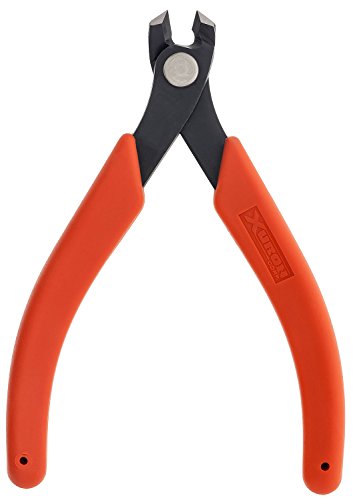
Xuron Vertical Track Cutter 2175M
$21.25Cuts rail cleanly with almost no distortion, which is what stops a kink at every joint. The vertical handle geometry lets you cut rail already laid on the layout.
Best for: cutting rail in place
Check price on Amazon
Woodland Scenics Foam Nails 2 inch 75 Pack
$9.24Holds foam roadbed and track down while the adhesive sets, then pulls out. Track pins driven into foam do nothing on their own.
Best for: holding track down while glue cures
Check price on AmazonEasement offset by radius, HO scale
For a 50 foot HO boxcar, which is 6.89 inches, using an easement three times the car length. The offset is how far the main curve moves inward from where it would have been without the easement.
Into a 24 inch radius curve, a 50 foot HO car wants a 20.7 inch easement and the main curve shifts inward by 0.74 inches.
| Curve radius | Easement length | Offset | Tangent shift |
|---|---|---|---|
| 18 in | 20.7 in | 0.989 in | 10.33 in |
| 22 in | 20.7 in | 0.809 in | 10.33 in |
| 24 in | 20.7 in | 0.741 in | 10.33 in |
| 30 in | 20.7 in | 0.593 in | 10.33 in |
| 36 in | 20.7 in | 0.494 in | 10.33 in |
Sharper curves need a proportionally larger offset, because the offset varies inversely with radius. That is the arithmetic reason easements matter most exactly where space is tightest.
The longer the car, the longer the easement
Into a 24 inch radius curve in HO, for three different car lengths.
An 85 foot HO passenger car wants a 35.1 inch easement into a 24 inch curve, against 20.7 inches for a 50 foot boxcar.
| Equipment | Model length | Easement length | Offset |
|---|---|---|---|
| 40 ft boxcar | 5.51 in | 16.5 in | 0.475 in |
| 50 ft boxcar | 6.89 in | 20.7 in | 0.741 in |
| 85 ft passenger car | 11.71 in | 35.1 in | 2.143 in |
How to actually lay one
You do not need to calculate a spiral. Three practical methods, in order of how often they are used:
- The bent stick. Take a thin strip of wood or styrene a bit longer than the easement, pin one end along the straight track and the other along the curve, and let it spring into shape. Draw along it. The natural curve of a sprung strip is very close to the correct transition, which is why this method has survived for decades.
- Flex track's own stiffness. Lay the flex track through the transition without forcing it and let it take up its own curve, pinning only at the ends. Flex track resists a sharp change in radius for the same reason the bent stick works.
- Offset the curve and connect. Mark the main curve shifted inward by the offset from this calculator, then join it to the straight with a smooth freehand transition over the easement length. Precision here matters much less than smoothness.
The thing to avoid is forcing flex track into position with a pin every two inches, which produces a series of short straight segments with kinks between them and is worse than no easement at all.
When an easement is not worth it
Honesty is more useful than enthusiasm here. Easements are worth the effort on visible main line curves, where trains run at speed and long equipment is involved. They matter most on sharp curves, because the offset and the jolt both grow as the radius shrinks.
They are largely pointless on industrial spurs and in yards, where everything moves at walking pace, the cars are short, and the space an easement consumes is space a yard track badly needs. They are also impossible to fit into sectional track without cutting it, so a set track layout will not have them and will still run perfectly well.
The one place people over-invest is a hidden curve. An easement inside a tunnel improves running slightly and looks like nothing at all, so if space is short, spend it on the visible curve instead.
Frequently asked questions
What is a curve easement on a model railroad?
A short transition at each end of a curve where the radius tightens gradually from straight to the full curve, instead of changing at a single joint. It stops the sideways jerk as a car enters the curve, reduces coupler swing and removes a common cause of derailments that only happen at one spot in one direction.
How long should an easement be?
Roughly three times the length of your longest car is the common rule of thumb, so about 20.7 inches for a 50 foot HO boxcar. Shorter easements still help; anything from one to three car lengths is a real improvement over none. This is hobby convention rather than a published standard.
How much does the curve shift inward?
By the easement length squared divided by 24 times the radius, which for a 20.7 inch easement into a 24 inch curve is about 0.74 inches. The offset grows as the radius shrinks, so sharp curves need proportionally more room for their easements, which is unhelpful given sharp curves exist because room is short.
Do I need to calculate the spiral exactly?
No. Spring a thin flexible strip between the straight and the curve and draw along it. A sprung strip naturally takes very close to the correct transition shape, which is why the bent stick method has outlasted every attempt to formalise it. Smoothness matters far more than mathematical precision.
Can I put easements on sectional track?
Not without cutting it. Sectional track comes in fixed radii with no transition pieces, so a set track layout goes from straight to full curve at a joint. That is one of the practical reasons people move to flex track, though plenty of sectional layouts run perfectly well without easements.
Are easements worth it everywhere on the layout?
No. They are worth the space on visible main line curves where trains run at speed with long equipment. They are largely pointless in yards and on industrial spurs, where everything moves slowly and short cars are the norm, and the space would be better spent on track length. Hidden curves are the lowest priority of all.
Researched, not professional advice. This page is compiled from published manufacturer specifications, instruction manuals, published NMRA standards and recommended practices, and owner-review consensus, not hands-on testing. Figures described as a rule of thumb are hobby convention rather than a standard, and they are labelled that way wherever they appear. Always check a radius, a clearance or a grade against your own equipment before you cut wood or lay rail, because manufacturers vary and so does what your specific models will tolerate. Any permanent mains wiring in a layout room is work for a licensed electrician to your local code.