Minimum radius in N
What radius does a 60 foot high cube boxcar need in N scale?
Quick answer
A 60 foot high cube boxcar scales to 4.5 inches in N, so it needs about a 13.5 inch radius for reliable running using the three times car length rule, or 15.8 inches for it to look right. A full circle at 13.5 inches needs roughly 31 inches of width. 11.3 inches is the absolute sharp minimum.
The working rule in this hobby is that minimum radius is a multiple of the length of the longest thing you run. It is a rule of thumb rather than a published standard, and it predicts reality well. A 60 foot high cube boxcar is 60 prototype feet, which at 1:160 is 4.5 inches over the couplers.
A high cube auto parts boxcar. Long enough that overhang starts to show on tight curves. For a car the whole body is rigid between the trucks, so overhang on a curve is at its worst in the middle of the car and at the ends. Long cars on sharp curves sideswipe each other on parallel tracks.
For context, the classic N train set curve is 9.75 inches. That is sharper than this equipment's absolute minimum of 11.3 inches, so a set track oval will not run it at all. This is the single most common disappointment in the hobby: the locomotive arrives and will not go round the circle that came in the box.
On this page
Radius for a 60 foot high cube boxcar in N at four standards
The four standards the hobby uses, from the sharpest curve the equipment will tolerate to the radius at which nothing is compromised. The space column is the width a full circle needs including two inches of clearance each side, which is the number that actually decides what fits in your room.
A 60 foot high cube boxcar in N scale needs a 13.5 inch radius at the conventional three times car length standard, and a full circle at that radius takes 31 inches of width.
| Standard | Multiple of car length | Radius | Diameter | Width needed | What it means |
|---|---|---|---|---|---|
| Sharp | 2.5 times | 11.3 in | 22.5 in | 26.5 in | It will go round, and it will look like it is going round. Overhang is obvious, long cars sideswipe on parallel tracks, and some equipment will not track at all. |
| Conventional | 3 times | 13.5 in | 27 in | 31 in | The usual compromise. Almost everything sold for the scale will run reliably, and the overhang is visible but not embarrassing. |
| Broad | 3.5 times | 15.8 in | 31.5 in | 35.5 in | Long passenger cars and big articulated steam start to look right rather than merely working. This is where most people wish they had started. |
| Generous | 4 times | 18 in | 36 in | 40 in | Nothing is compromised and everything looks correct. It costs area, and area is the one thing a home layout never has spare. |
The car length multiple is hobby convention, not a published standard. NMRA Recommended Practice RP-11 is the standards-body document on curvature and equipment, and a manufacturer stated minimum radius for a specific model always takes priority over any rule of thumb.
The same equipment in every scale
If you have not committed to a scale yet, this is the table that should decide it. The same prototype car needs very different space in N, HO and O, and the width column is what has to fit in the room you actually have.
A 60 foot high cube boxcar needs a 13.5 inch radius in N and 45 inches in O, which is why the same room holds a very different railroad in each scale.
| Scale | Model length | Sharp | Conventional | Broad | Width for a circle |
|---|---|---|---|---|---|
| N (1:160) | 4.5 in | 11.3 in | 13.5 in | 15.8 in | 31 in |
| HO (1:87.1) | 8.27 in | 20.7 in | 24.8 in | 28.9 in | 53.6 in |
| O (1:48) | 15 in | 37.5 in | 45 in | 52.5 in | 94 in |
What happens if you use a sharper curve anyway
Nothing dramatic, usually. The train goes round. What you get instead is a set of smaller problems that add up:
- Overhang. The middle of the car swings inside the curve and the ends swing outside it. On a 4.5 inch car at 11.3 inches this is clearly visible and it is the reason sharp curves look like a toy train set.
- Sideswiping on parallel track. Two long cars passing on adjacent curved tracks can touch, which is why track centre spacing has to increase on curves. In N the straight track spacing is about 0.98 inches and a sharp curve needs more.
- Coupler pull. On a tight curve the couplers are at an angle to each other, and the sideways component of the pull lifts the inside wheel. This is the mechanism behind the derailment that only happens when the train is long.
- Uncoupling on the curve. Knuckle couplers at a steep angle can pull apart under load, which is the fault that seems random until you notice it always happens at the same place.
The honest summary: sharp curves are a legitimate choice when space is the binding constraint, and you should make that choice knowing what it costs rather than discovering it after the track is down.
How much room does that actually take?
Radius is measured to the centre of the track, so a full circle is twice the radius plus the width of the roadbed and something to stop the train hitting the wall. These are the practical widths.
A full circle at the conventional 13.5 inch radius needs about 31 inches, or 2.6 feet, of clear width.
| Standard | Radius | Full circle width | In feet | Track length in a full circle |
|---|---|---|---|---|
| Sharp | 11.3 in | 26.5 in | 2.2 ft | 71 in |
| Conventional | 13.5 in | 31 in | 2.6 ft | 84.8 in |
| Broad | 15.8 in | 35.5 in | 3 ft | 99.3 in |
| Generous | 18 in | 40 in | 3.3 ft | 113.1 in |
A circle is the worst case. A layout that runs along a wall and turns at the ends only needs this width at the ends, which is why a shelf layout with a return loop fits where a table layout does not.
Track and equipment for a 13.5 inch radius in N
Chosen against the numbers on this page rather than from a general list, so the recommendation cannot contradict the arithmetic above.

Kato N Scale Unitrack 186 mm Straight Track 4 per Package
$9.80The standard N scale Unitrack straight, 7 5/16 inches long. The building block for lengthening a Unitrack layout.
Best for: extending an N scale Unitrack layout
Check price on Amazon
Kato N Scale 9 3/4 inch Double Track Straight Concrete Ties 2 Pack
$13.50Double track in one section with correct track centre spacing built in, which removes the commonest measuring error on a double track main line.
Best for: N scale double track with the spacing decided for you
Check price on Amazon
Woodland Scenics HO 2 foot Track-Bed Strips 12 Pack
$17.94Foam roadbed in pre-cut strips with the shoulder profile already there. Quieter than cork and it will not dry out and crumble the way cork can after some years.
Best for: HO roadbed that stays quiet
Check price on Amazon
Woodland Scenics N 2 foot Track-Bed Strips 36 Pack
$24.73The N scale profile, which is correctly narrower rather than just thinner. Thirty six strips is 72 feet, enough for a whole small layout.
Best for: an entire N scale layout in one purchase
Check price on Amazon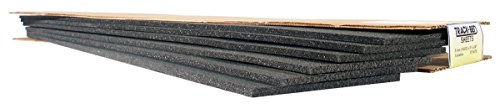
Woodland Scenics HO and O Track-Bed Sheets 6 Pack
$18.29Sheet rather than strip, for yards and industrial areas where the track is too close together for individual roadbed shoulders to make sense.
Best for: yards and engine terminals
Check price on Amazon
Bachmann GP40 DCC Sound Locomotive Burlington Northern N Scale
$227.90 Specs and fitmentFactory DCC sound in N scale at a mainstream price, on a four axle road switcher that suits almost any modern era layout.
Best for: a first sound equipped N scale diesel
Check price on AmazonHow we chose
We did not test these products in person and we never claim to. Picks are researched from manufacturer specification sheets and instruction manuals, published NMRA standards and recommended practices, and the recurring themes in verified owner reviews. Every pick is matched to a real scale, a real minimum radius or a real current draw rather than to a price bracket, and it is placed in the tier where its capability actually belongs. Where a product is wrong for most layouts we say so on the page, and where a figure is a hobby rule of thumb rather than a published standard we say that too.
Sources
- NMRA Recommended Practice RP-11, Curvature and Rolling Stock
- NMRA Standard S-1.2, General Standard Scales
- Manufacturer published minimum radius figures on current product listings
Frequently asked questions
What is the minimum radius for a 60 foot high cube boxcar in N scale?
About 13.5 inches for reliable running, using the convention that minimum radius is roughly three times the length of the longest car. The model is 4.5 inches long in N. It will physically negotiate 11.3 inches at the cost of obvious overhang, and 15.8 inches is where it starts to look correct rather than merely working.
Will a 60 foot high cube boxcar run on N train set track?
No. The standard 9.75 inch N set track curve is sharper than the 11.3 inch absolute minimum this equipment needs, so it will either derail or bind. You need flex track or a larger sectional radius, which is the usual reason people move away from set track.
Is the three times car length rule an actual standard?
No, and that distinction matters. It is hobby convention, widely used because it predicts reliable running well. The NMRA publishes Recommended Practice RP-11 on curvature and rolling stock, which is the standards-body document on the subject. A manufacturer's stated minimum for a specific model is derived from that model's mechanism and always takes priority over any general rule.
How much space does a N scale circle at this radius need?
About 31 inches, which is 2.6 feet, of clear width for a full circle at the conventional 13.5 inch radius. That includes two inches of margin each side so the train is not running along the very edge of the benchwork. A layout that only curves at the ends needs this width at the ends alone.
Does a longer car always need a bigger radius than a locomotive?
Not necessarily. For a car the body is rigid between the trucks, so length is the whole story. For a steam locomotive the rigid wheelbase between the driving wheels usually decides it, so a short locomotive with many coupled drivers can be fussier than a longer car. For a diesel the trucks pivot, which makes it more tolerant than its length suggests.
What is the cheapest way to get a broader radius?
Flex track. Sectional curves come in fixed radii and you are stuck with what the system offers, while flex track lets you lay whatever radius the space allows, including the awkward intermediate numbers. It costs less per foot than sectional track and it is the standard way layouts are built once people stop using the track that came in the box.
Researched, not professional advice. This page is compiled from published manufacturer specifications, instruction manuals, published NMRA standards and recommended practices, and owner-review consensus, not hands-on testing. Figures described as a rule of thumb are hobby convention rather than a standard, and they are labelled that way wherever they appear. Always check a radius, a clearance or a grade against your own equipment before you cut wood or lay rail, because manufacturers vary and so does what your specific models will tolerate. Any permanent mains wiring in a layout room is work for a licensed electrician to your local code.