DCC boosters
Digitrax DB210 8 Amp Auto-Reversing Booster Review
Quick answer
The Digitrax 8 Amp Auto-Reversing DCC Booster at $212.99 delivers 8 amps of auto-reversing DCC power to a second district on a Digitrax LocoNet layout, but it is not a command station and cannot generate the DCC signal it amplifies on its own.
The Digitrax 8 Amp Auto-Reversing DCC Booster is a high-capacity booster built for Digitrax LocoNet layouts that have outgrown a single command station's amperage, with auto-reversing capability built in for reversing loops and wyes on the same power district. That combination of high amperage and auto-reversing is a genuine convenience for a larger layout.
It is still, at its core, an amplifier rather than a brain, and that distinction matters for anyone shopping for their first booster.
On this page
What the DB210 actually adds
Digitrax's published specifications describe the Digitrax 8 Amp Auto-Reversing DCC Booster as an 8 amp auto-reversing booster for LocoNet systems, meaning it both amplifies the DCC signal for a second power district and automatically handles polarity reversal for a wye or reversing loop wired into that district, a function that would otherwise require a separate auto-reversing module.
The limitation to plan around
A booster is not a command station and cannot work alone. The Digitrax 8 Amp Auto-Reversing DCC Booster needs a working Digitrax command station, such as the Digitrax Zephyr Express Starter Set or Digitrax Evolution Express Advanced 5A/8A Starter Set, generating the base DCC signal before it has anything to amplify. Buying a booster to replace a broken or underpowered command station rather than to supplement a working one is a common and avoidable mistake according to the consensus of verified owner reports.
Alternatives depending on the amperage needed
Budget pick: the Digitrax DB210 Single 3/5/8 Amp Auto-Reversing DCC Booster offers selectable 3, 5 or 8 amp output from the same unit, useful if the exact power district size is not yet finalized.
Alternative configuration: the Digitrax DB210 Booster Advanced with Single Auto Reversing 8A packages the same auto-reversing 8 amp capability in Digitrax's advanced booster line.
Alternative brand and ecosystem: the Bachmann E-Z Command DCC 5 Amp Power Booster for All Scales is worth comparing only if the layout runs on Bachmann E-Z Command rather than Digitrax LocoNet, since boosters generally do not cross ecosystems. The Digitrax versus NCE comparison is a useful read before committing further hardware to either ecosystem.
Wiring the new power district correctly
The DB210's rated amperage only reaches the locomotives running on it if the power district around it is wired correctly. That means a properly sized bus wire run from the booster to the rails, feeder wires dropped every few feet rather than relying on rail joiners to carry current, and a clean electrical gap separating the new district from the command station's own district so the two do not short against each other. The bus wire gauge calculator is worth running against the specific district's length and the booster's 8 amp rating before wiring anything, since undersized bus wire quietly throws away a meaningful share of the booster's rated capacity as voltage drop over distance.
DCC boosters compared side by side
Published specifications for the DB210 against the boosters it is most often cross-shopped with.
| Model | Price | Output current | Scales supported |
|---|---|---|---|
 Digitrax 8 Amp Auto-Reversing DCC Booster Digitrax 8 Amp Auto-Reversing DCC Booster | $212.99 | 8 A | N, HO and large scale |
 Digitrax DB210 Single 3/5/8 Amp Auto-Reversing DCC Booster Digitrax DB210 Single 3/5/8 Amp Auto-Reversing DCC Booster | $180.81 | 8 A | N, HO and large scale |
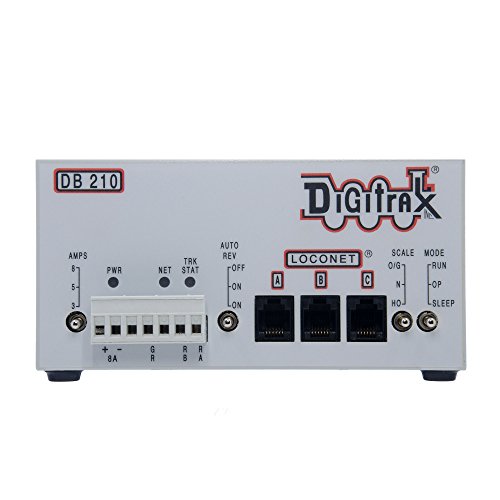 Digitrax DB210 Booster Advanced with Single Auto Reversing 8A Digitrax DB210 Booster Advanced with Single Auto Reversing 8A | $146.99 | 8 A | - |
 Bachmann E-Z Command DCC 5 Amp Power Booster for All Scales Bachmann E-Z Command DCC 5 Amp Power Booster for All Scales | $297.56 | 5 A | All scales |
How we chose
We did not test these products in person and we never claim to. Picks are researched from manufacturer specification sheets and instruction manuals, published NMRA standards and recommended practices, and the recurring themes in verified owner reviews. Every pick is matched to a real scale, a real minimum radius or a real current draw rather than to a price bracket, and it is placed in the tier where its capability actually belongs. Where a product is wrong for most layouts we say so on the page, and where a figure is a hobby rule of thumb rather than a published standard we say that too.
Sources
- Digitrax published product specifications for the DB210 booster line
- The consensus of verified owner reviews on Digitrax booster installation and auto-reversing
Frequently asked questions
Can the Digitrax DB210 booster work without a command station?
No. The manufacturer's published specifications describe it as a booster that amplifies an existing LocoNet DCC signal for a second power district. It needs a working command station, such as the Digitrax Zephyr Express Starter Set, generating that signal in the first place, and outputs nothing on its own.
What does auto-reversing mean on a booster?
It means the booster automatically detects and corrects a short circuit caused by a reversing loop or wye track section changing polarity, rather than requiring a separate dedicated auto-reversing module wired in between. The Digitrax 8 Amp Auto-Reversing DCC Booster includes this feature built in at its published 8 amp rating.
How many amps do I actually need from a booster?
That depends on how many sound-equipped locomotives, powered turnouts and lit cars will draw current on the new power district simultaneously. The DCC power budget calculator turns that list into a specific amperage requirement rather than a rule of thumb.
Does the DB210 work with non-Digitrax command stations?
It is designed and marketed for Digitrax LocoNet systems specifically. Manufacturers do not generally document cross-brand booster compatibility as supported, so pairing it with a non-Digitrax command station is not something the consensus of verified owner reports recommends relying on.
What is the difference between the DB210 8A and the DB210 single?
The Digitrax 8 Amp Auto-Reversing DCC Booster is fixed at 8 amps with auto-reversing, while the Digitrax DB210 Single 3/5/8 Amp Auto-Reversing DCC Booster offers selectable 3, 5 or 8 amp output from the same unit. The single-select version gives more flexibility if the eventual power district size is not yet finalized.
What wire gauge does an 8 amp booster district need?
An 8 amp district generally needs heavier bus wire than a smaller 3 or 5 amp district, especially over a longer run. The bus wire gauge calculator gives an exact recommendation once the run length and the booster's rated amperage are entered.
Researched, not professional advice. This page is compiled from published manufacturer specifications, instruction manuals, published NMRA standards and recommended practices, and owner-review consensus, not hands-on testing. Figures described as a rule of thumb are hobby convention rather than a standard, and they are labelled that way wherever they appear. Always check a radius, a clearance or a grade against your own equipment before you cut wood or lay rail, because manufacturers vary and so does what your specific models will tolerate. Any permanent mains wiring in a layout room is work for a licensed electrician to your local code.