O gauge
O Gauge Starter Layout with Remote Control
Quick answer
A three-rail O gauge starter layout costs about $658 with a LionChief set, a proper 80 watt transformer rather than the set controller, and a track cleaning car. It is heavier, louder and far more durable with children than scale HO.
Three-rail O gauge is a different hobby from scale HO and N, and pretending otherwise does nobody any favours. The models are large, heavy and durable, the third rail is visible and nobody minds, curves are sharp by scale standards, and the whole thing is built to survive being handled.
That is exactly why it is the right answer in some houses. An O gauge train survives a child picking it up. An N scale locomotive does not survive being looked at too hard.
The one upgrade worth making immediately is the transformer. Set controllers are sized for the set and nothing else, and the moment you add lighted accessories or a second train they run out. An 80 watt transformer is the usual first purchase after the set itself.
The complete build: $658
$658A floor, a table or a sheet of plywood. O gauge curves are large, so check the space: a common starter circle needs around 31 inches of diameter at minimum, and more is much better.
Set and power
The set includes a controller sized for the set. The transformer is the upgrade that lets the layout grow.
| Item | Qty | Each | Line |
|---|---|---|---|
 Lionel Union Pacific Flyer LionChief 5.0 Electric O Gauge Train Set Locomotive, cars, track and remote, on the current LionChief 5.0 electronics Lionel Union Pacific Flyer LionChief 5.0 Electric O Gauge Train Set Locomotive, cars, track and remote, on the current LionChief 5.0 electronics | 1 | $357.42 | $357.42 |
 Lionel CW-80 Transformer An 80 watt transformer, the usual first upgrade over a set controller Lionel CW-80 Transformer An 80 watt transformer, the usual first upgrade over a set controller | 1 | $185.78 | $185.78 |
| Set and power subtotal | $543.20 | ||
Keeping it running
Three-rail track picks up dust like anything else, and O gauge locomotives are heavy enough that dirty track shows as stalling rather than flickering.
| Item | Qty | Each | Line |
|---|---|---|---|
 Walthers SceneMaster Bright Boy Track Cleaner Standard Grit Abrasive Revives badly oxidised rail, though it is a recovery tool rather than a routine one Walthers SceneMaster Bright Boy Track Cleaner Standard Grit Abrasive Revives badly oxidised rail, though it is a recovery tool rather than a routine one | 1 | $11.31 | $11.31 |
 Bachmann Track and Rail Cleaner 6 fl oz Lifts dirt rather than abrading the railhead, which is better for regular maintenance Bachmann Track and Rail Cleaner 6 fl oz Lifts dirt rather than abrading the railhead, which is better for regular maintenance | 1 | $17.38 | $17.38 |
| Keeping it running subtotal | $28.69 | ||
Scenery, if you want it
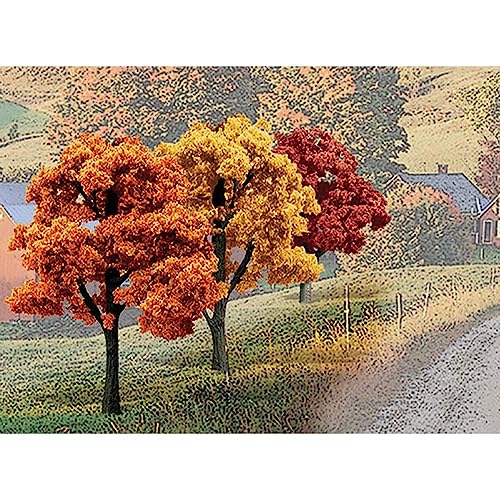
Many O gauge layouts stay on a carpet or a bare board and that is a legitimate choice. If you do scenic it, use coarse ballast: fine grade vanishes at this size.


Total for this build
Equipment only, at the listed prices when this page was compiled.
How three-rail O differs from scale modelling
Set against HO, so the trade is explicit rather than assumed.
O gauge is roughly 1.8 times the linear size of HO, so the same railroad takes about three and a quarter times the area, in exchange for durability and remote control as standard.
| Aspect | Three-rail O | HO scale |
|---|---|---|
| Proportion | 1:48 | 1:87.1 |
| Track gauge | 1.25 in | 0.65 in |
| Area for the same railroad | About 3.25 times HO | Baseline |
| Control | Remote or Bluetooth as standard | DC or DCC, usually bought separately |
| Durability | Survives being handled | Does not |
| Realism | Third rail visible, sharp curves | Closer to scale throughout |
What you can skip
A flagship transformer. The largest Lionel transformers cost more than this entire layout and are sized for a large multi-train railroad. An 80 watt unit runs one train and a reasonable number of accessories, which is what a starter layout has.
Scenery, initially. Unlike HO and N, a great many O gauge layouts are happily run on a carpet or a bare board, and the trains are the point. Add scenery if you want it, not because the hobby expects it.
What to upgrade first
More track, and wider curves. O gauge curves are sharp by scale standards and the set circle is the sharpest of all. Wider curves let longer and better looking equipment run, and they are the thing that most changes how an O gauge layout looks in motion.
Frequently asked questions
Is O gauge good for children?
It is the best of the common scales for it. The models are large enough to pick up without damage, the couplers work without fine motor control, remote or Bluetooth operation is standard, and the whole thing is built to survive handling. An N scale locomotive in the same household would not last a week.
Do I need to upgrade the transformer that comes with the set?
Not to run the set, and yes as soon as you add anything. Set controllers are sized for the set and nothing more, so lighted accessories or a second train exhaust them quickly. An 80 watt transformer is the usual first purchase and covers a modest layout comfortably.
How much space does O gauge need?
Considerably more than HO, roughly three and a quarter times the area for the same railroad, because O is about 1.8 times the linear size. A common starter circle needs around 31 inches of diameter as a minimum, and wider curves look and run much better. Measure before committing to the scale.
Why is there a third rail?
It is how the system carries power: the centre rail is one side of the circuit and both outer rails the other, which makes wiring reversing loops trivial and was a sensible engineering choice when the system was designed. It is visible and unrealistic, and within three-rail O gauge nobody minds, which is part of the tradition.
Can I run O gauge on the floor?
Yes, and plenty of people do, which is one of its real advantages. The track is robust enough to be laid on a carpet and taken up again, the trains survive it, and there is no wiring to speak of with a modern LionChief set. A great many O gauge layouts are seasonal rather than permanent.
What ballast grade does O gauge need?
Coarse. Fine ballast simply vanishes at this size and reads as sand rather than stone. This is the mirror image of the mistake people make in N scale with medium ballast, and the grade matters as much as the colour for making track look like track rather than rail on a board.
Researched, not professional advice. This page is compiled from published manufacturer specifications, instruction manuals, published NMRA standards and recommended practices, and owner-review consensus, not hands-on testing. Figures described as a rule of thumb are hobby convention rather than a standard, and they are labelled that way wherever they appear. Always check a radius, a clearance or a grade against your own equipment before you cut wood or lay rail, because manufacturers vary and so does what your specific models will tolerate. Any permanent mains wiring in a layout room is work for a licensed electrician to your local code.