Turnout geometry in HO
What is a number 5 turnout in HO scale?
Quick answer
A number 5 turnout diverges one unit sideways for every 5 units forward, giving a frog angle of 11.42 degrees. In HO scale at 1.79 inch track centres it needs 8.95 inches to reach a parallel track, and a crossover between two parallel tracks takes about 17.9 inches. A workable compromise for branch line and secondary track where a number 6 will not fit.
A turnout's number is the one thing you need to understand about turnouts, and it is simpler than it looks. The number is the rate at which the diverging route pulls away from the straight one, measured at the frog: a number 5 moves one unit sideways for every 5 units forward. That is the entire definition, and every other figure on this page follows from it by geometry.
Two consequences matter. The higher the number, the shallower the angle and the gentler the divergence, so the better long equipment takes it. And the higher the number, the longer the turnout, so the more space it costs. Choosing a turnout number is choosing a point on that trade.
On this page
Number 5 geometry in HO scale
Everything here is derived from the definition of the number. The frog angle is exact geometry, and the ladder reach is the track centre spacing multiplied by the turnout number.
A number 5 turnout has a 11.42 degree frog and needs 8.95 inches of run to reach a parallel track at 1.79 inch centres in HO.
| Figure | Value | Where it comes from |
|---|---|---|
| Turnout number | 5 | One unit of divergence for every 5 units of travel |
| Frog angle | 11.42 degrees | Two times the arctangent of one over twice the number |
| Offset after 12 inches | 2.4 in | Distance divided by the number |
| Offset after 24 inches | 4.8 in | Distance divided by the number |
| Track centre spacing | 1.79 in | Scaled from 13 prototype feet at 1:87.1 |
| Reach to a parallel track | 8.95 in | Track centres multiplied by the turnout number |
| Crossover between two tracks | 17.9 in | Two turnouts back to back |
Track centre spacing is a starting figure scaled from prototype practice. Curves need more, and NMRA Standard S-8 is the standards document on clearances. A manufacturer turnout also has its own overall length, which includes the straight rail before and after the frog and is longer than the geometry alone implies.
How the numbers compare in HO
Every common turnout number in this scale, so the trade between space and gentleness is visible in one place. The reach column is what a yard ladder costs per track.
In HO scale, going from a number 4 to a number 8 turnout halves the frog angle from 14.25 to 7.15 degrees and doubles the reach to a parallel track from 7.16 to 14.32 inches.
| Number | Frog angle | Reach to parallel track | What it suits |
|---|---|---|---|
| Number 4 | 14.25 degrees | 7.16 in | Tight industrial spurs and cramped yards, where the space matters more than the look and nothing long has to take the diverging route. |
| Number 5 | 11.42 degrees | 8.95 in | A workable compromise for branch line and secondary track where a number 6 will not fit. |
| Number 6 | 9.53 degrees | 10.74 in | The general purpose turnout. Yard throats, passing sidings and most main line work. |
| Number 8 | 7.15 degrees | 14.32 in | Main line crossovers and anywhere long passenger equipment takes the diverging route at speed. |
| Number 10 | 5.72 degrees | 17.9 in | High speed main line and display trackwork. Long, expensive, and unmistakably correct. |
What the number costs you in a yard
This is where turnout number stops being academic. A yard ladder is a series of turnouts, each one peeling off a track, and each one needs its full reach before the next can start. With a number 5 in HO at 1.79 inch centres, every track in the ladder costs 8.95 inches of length.
A five track yard therefore spends about 35.8 inches just on the ladder before a single car can be stood anywhere. On a small layout that is often more length than the yard tracks themselves, which is why sharp turnouts survive in yards despite being the wrong choice everywhere else.
The honest guidance: use the highest number you can afford on the main line, where trains move fastest and the diverging route is taken at speed, and accept a lower number in yards and on industrial spurs where everything moves at walking pace and nothing long goes through the diverging route. A number 6 on the main and a number 4 in the yard is a very common and entirely defensible combination.
Frog type matters as much as the number
The number tells you the geometry. It says nothing about whether the frog carries current, and that is the other decision.
An insulated or dead frog has a plastic frog casting, so there is a short gap where no power reaches the wheels. It is simple to wire, it cannot short, and a short wheelbase locomotive can stall on it. A powered or live frog carries current and is switched to match the route, which eliminates the stall, and it must be wired correctly or it shorts the moment a wheel bridges the rails.
The practical rule: with a modern locomotive that has all wheel pickup and a decent flywheel, a dead frog is usually fine. With small switchers, short wheelbase steam, or anywhere you want genuinely slow reliable movement, a powered frog is worth the wiring. A keep alive circuit in the decoder solves the same problem from the other direction.
Turnouts and the tools to lay them in HO
Chosen against the numbers on this page rather than from a general list, so the recommendation cannot contradict the arithmetic above.

Atlas Code 100 Nickel Silver Mark 4 Number 8 Turnout Left Hand HO Scale
$30.72A number 8 is long and shallow, which is what long passenger equipment needs to take the diverging route without lurching. It costs a lot of length to install.
Best for: main line crossovers where long cars diverge
Check price on Amazon
Atlas Code 83 Nickel Silver Wye Turnout HO Scale
$24.84A wye splits the difference by curving both routes equally, so it fits a junction into much less length than a left or right turnout of the same effective radius.
Best for: a symmetrical junction in a tight space
Check price on Amazon
Atlas Code 83 Nickel Silver Manual Snap Switch Left HO Scale
$26.98A snap switch is geometrically a sharp turnout designed to fit sectional track spacing. Convenient, and sharper than a number 6, so keep long equipment off the diverging route.
Best for: sidings on a sectional track layout
Check price on Amazon
Atlas Code 83 Nickel Silver Manual Snap Switch Right HO Scale
$24.31The right hand version. Turnouts are almost always bought in pairs, because a crossover needs one of each.
Best for: the other half of a crossover
Check price on Amazon
Atlas HO Code 83 Remote Right-Hand Turnout with Switch Machine
$34.23Ships with the switch machine fitted, so it throws from a control panel without buying and mounting a separate motor. The machine sits beside the track and is visible.
Best for: remote control without a separate switch machine install
Check price on Amazon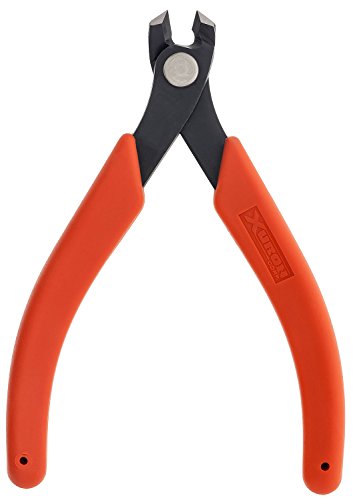
Xuron Vertical Track Cutter 2175M
$21.25Cuts rail cleanly with almost no distortion, which is what stops a kink at every joint. The vertical handle geometry lets you cut rail already laid on the layout.
Best for: cutting rail in place
Check price on AmazonHow we chose
We did not test these products in person and we never claim to. Picks are researched from manufacturer specification sheets and instruction manuals, published NMRA standards and recommended practices, and the recurring themes in verified owner reviews. Every pick is matched to a real scale, a real minimum radius or a real current draw rather than to a price bracket, and it is placed in the tier where its capability actually belongs. Where a product is wrong for most layouts we say so on the page, and where a figure is a hobby rule of thumb rather than a published standard we say that too.
Sources
- NMRA Standard S-8, Track Centers and Clearances
- NMRA Standard S-3.2, Trackwork for Standard Scale
- Manufacturer published turnout dimensions on current product listings
Frequently asked questions
What does number 5 mean on a turnout?
It is the rate of divergence measured at the frog: the diverging route moves one unit sideways for every 5 units forward. That gives a frog angle of 11.42 degrees. A higher number is a shallower, gentler turnout that takes more space, and a lower number is sharper and shorter.
What is the frog angle of a number 5 turnout?
11.42 degrees. It comes straight from the number: the angle is twice the arctangent of one divided by twice the number. This is exact geometry rather than a manufacturer figure, so it holds for a number 5 turnout from any maker and in any scale.
How much space does a number 5 turnout need in HO scale?
To reach a parallel track at 1.79 inch centres it needs 8.95 inches of run, and a crossover between two parallel tracks takes about 17.9 inches. The packaged turnout is longer still, because it includes straight rail before the points and after the frog.
Is a number 5 turnout good enough for a main line?
Not really. A number 5 is sharp, and long equipment taking the diverging route at speed will lurch and may uncouple. It is the right choice for industrial spurs and cramped yards where everything moves slowly. Use a number 6 or higher on the main line if you possibly can.
Should I buy powered frog or insulated frog turnouts?
Insulated frog turnouts are simpler to wire and cannot short, at the cost of a short dead spot that can stall a short wheelbase locomotive. Powered frog turnouts eliminate the stall and must be wired correctly or they short. Modern locomotives with all wheel pickup usually cope with a dead frog, and small switchers often do not.
Can I mix turnout numbers on one layout?
Yes, and you should. The sensible pattern is the highest number you can fit on the main line where trains run fast and long, and lower numbers in yards and on spurs where everything moves at walking pace and short cars are the norm. A number 6 main and a number 4 yard is a very common combination.
Researched, not professional advice. This page is compiled from published manufacturer specifications, instruction manuals, published NMRA standards and recommended practices, and owner-review consensus, not hands-on testing. Figures described as a rule of thumb are hobby convention rather than a standard, and they are labelled that way wherever they appear. Always check a radius, a clearance or a grade against your own equipment before you cut wood or lay rail, because manufacturers vary and so does what your specific models will tolerate. Any permanent mains wiring in a layout room is work for a licensed electrician to your local code.