Turntables
Best Model Railroad Turntables
Quick answer
The best full-featured turntable for an HO scale engine terminal is the Walthers Cornerstone Motorized 110 foot Turntable with DCC HO Scale at $334.00, because its motorized DCC indexing stops the bridge exactly on each stall track every time, instead of relying on the operator to align it by eye.
A turntable's real job is not turning a locomotive around, a wye does that for far less money and far less benchwork depth. A turntable's job is presenting a locomotive to a specific stall track in an engine terminal, and doing it precisely enough that the locomotive does not step off a gap between the bridge rail and the stall rail. That precision is called indexing, and it is most of what separates a $50 manual turntable from a $300 motorized, DCC-controlled one like the Walthers Cornerstone Motorized 110 foot Turntable with DCC HO Scale.
If turning a locomotive is all you need, see turntable versus wye before committing to a turntable at all.
On this page
- What does "indexing" mean, and why does it cost so much?
- Which turntable should I buy?
- Can I motorize a manual turntable instead of buying one already motorized?
- Do I actually need a turntable, or would a wye work just as well?
- How much does a locomotive have to overhang a turntable bridge before it becomes a problem?
- Beginner: a manual turntable for a small yard or engine terminal
- Intermediate: a kit-built turntable for a modeler who wants to detail it themselves
- Expert: motorized, DCC-indexed alignment for a full engine terminal
What does "indexing" mean, and why does it cost so much?
Indexing is the bridge automatically stopping in exact alignment with a stall track every time it is commanded there, rather than the operator nudging it by eye or by a mechanical detent and hoping the rails line up. A locomotive rolling across a misaligned gap between the bridge rail and the stall rail can catch a wheel flange and derail right at the pit, which is an awkward spot to rerail from. Motorized, electronically indexed turntables like the Walthers Cornerstone Motorized 110 foot Turntable with DCC HO Scale solve this with a DCC-addressable drive that always returns to the same precise stops. A manual turntable like the Atlas Model 305 Turntable Manual Nickel Silver HO relies on the operator's eye and a detent mechanism, which is why it costs a fraction of the price.
Which turntable should I buy?
Diameter, drive type and DCC control vary across the lineup, and price tracks all three closely.
DCC-indexed motorized turntables cost roughly five times a manual one, and the difference is almost entirely automatic alignment.
| Turntable | Scale | Drive | Price |
|---|---|---|---|
| Atlas Model 305 Turntable Manual Nickel Silver HO | HO | Manual, hand-aligned | $51.22 |
| Walthers Cornerstone 90 foot Turntable HO Scale Structure Kit | HO | Structure kit, no motor included | $64.98 |
| Peco HO Scale Turntable Kit | HO | Kit, built and detailed by the modeler | $129.20 |
| Bachmann DCC-Equipped Motorized Electric Turntable HO Scale | HO | Motorized, DCC-equipped | $236.18 |
| Walthers Cornerstone Motorized 110 foot Turntable with DCC HO Scale | HO | Motorized, DCC-equipped indexing | $334.00 |
| Walthers Cornerstone Motorized 130 foot Turntable with DCC N Scale | N | Motorized, DCC-equipped indexing | $334.99 |
Can I motorize a manual turntable instead of buying one already motorized?
Yes, for the Atlas line specifically. The Atlas Model 305 Turntable Manual Nickel Silver HO pairs with a separate Atlas HO Turntable Motor Drive drive unit, which is a cheaper path to motorized operation than buying a fully assembled DCC-indexed turntable outright, though it will not have the same electronic stall-track indexing as a purpose-built DCC unit. It is a reasonable middle step if hand-aligning the bridge has become the bottleneck but a full DCC-indexed turntable is more than the layout needs.
Do I actually need a turntable, or would a wye work just as well?
If the only goal is turning a locomotive around to face the other direction, a wye or a reversing loop does that job for a fraction of the cost and a fraction of the benchwork depth a turntable pit requires. A turntable earns its cost and its space specifically as the visual and functional centerpiece of an engine terminal, storing and presenting several locomotives to a roundhouse or a service area, which a wye cannot do. See turntable versus wye for the fuller comparison.
How much does a locomotive have to overhang a turntable bridge before it becomes a problem?
A turntable bridge is only as long as the pit and the model it was designed around, and running a locomotive longer than that length means part of it overhangs the ends of the bridge while it turns. A small overhang is usually cosmetic, but enough overhang can cause the locomotive's front or rear truck to swing wide enough to clip scenery, a fascia, or an adjacent stall track as the bridge rotates, particularly on a smaller-diameter turntable paired with a long modern diesel or articulated steam locomotive. Manufacturer-stated bridge lengths, such as the 90, 110 or 130 foot prototype lengths named in these products, are the number to check against your longest locomotive before assuming any turntable in this lineup fits your roster.
This is also a reason to mock up clearance with your actual longest locomotive before committing benchwork to a turntable pit, the same caution that applies to curve radius elsewhere on a layout: a manufacturer's stated minimum or stated length is a real number to check against, not a guarantee that every locomotive you might eventually buy will fit.
Beginner: a manual turntable for a small yard or engine terminal
A manual turntable is inexpensive and works fine for a small yard with only a couple of stub-ended service tracks, where the operator can align the bridge by eye without much trouble.

Atlas Model 305 Turntable Manual Nickel Silver HO
$51.22The lowest-cost entry to a turntable, workable for a small yard with just a few stall tracks to align by hand.
Best for: A small yard or engine terminal with a couple of stall tracks
Check price on AmazonIntermediate: a kit-built turntable for a modeler who wants to detail it themselves
A kit costs less than a fully assembled motorized unit and lets you detail the pit, walls and bridge to match your own scenery rather than starting from a factory-finished appearance.

Peco HO Scale Turntable Kit
$129.20 Specs and fitmentA kit you assemble and detail yourself, priced below the motorized DCC options for modelers who want to build and finish it to match their own layout.
Best for: Modelers who want to detail and finish a turntable themselves
Check price on AmazonExpert: motorized, DCC-indexed alignment for a full engine terminal
An engine terminal with multiple stall tracks and regular locomotive movement is where indexing stops being a convenience and starts being the reason the terminal works reliably at all.
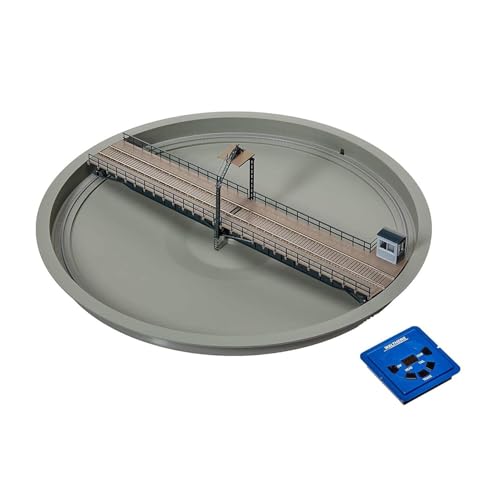
Walthers Cornerstone Motorized 110 foot Turntable with DCC HO Scale
$334.00Motorized, DCC-addressable indexing that returns to the same precise stop on every stall track, which is what a busy engine terminal actually needs.
Best for: A full engine terminal with multiple stall tracks in regular use
Check price on AmazonWho should not buy this tier: Skip a motorized, DCC-indexed turntable if you run four or five locomotives from a single storage track rather than a real multi-track engine terminal. A simple stub-ended lead or a small yard does the same storage job for a fraction of the cost and without the benchwork depth a turntable pit requires.
How we chose
We did not test these products in person and we never claim to. Picks are researched from manufacturer specification sheets and instruction manuals, published NMRA standards and recommended practices, and the recurring themes in verified owner reviews. Every pick is matched to a real scale, a real minimum radius or a real current draw rather than to a price bracket, and it is placed in the tier where its capability actually belongs. Where a product is wrong for most layouts we say so on the page, and where a figure is a hobby rule of thumb rather than a published standard we say that too.
Frequently asked questions
What does turntable indexing actually mean?
Indexing is the turntable bridge stopping in exact alignment with a specific stall track every time it is commanded there, rather than an operator nudging it into rough alignment by eye. Precise indexing is what keeps a locomotive from catching a wheel on a misaligned rail gap at the pit.
Do I need a turntable just to turn a locomotive around?
No. A wye or a reversing loop turns a locomotive around for far less cost and far less benchwork depth than a turntable pit requires. A turntable is worth its cost specifically as an engine terminal centerpiece that stores and presents locomotives to multiple stall tracks.
Can I motorize a manual Atlas turntable later?
Yes, Atlas sells a separate motor drive unit that pairs with its manual turntable, which is a cheaper upgrade path than buying a fully assembled motorized unit outright, though it will not match the electronic indexing precision of a purpose-built DCC turntable.
How much benchwork depth does a turntable need?
A turntable pit sits below the track surface and needs clearance underneath for the mechanism, in addition to the diameter of the bridge itself on the layout surface. This is a meaningfully deeper cutout than most other track features need, and it is worth mocking up before committing benchwork to it.
Is a kit turntable harder to get working reliably than a preassembled one?
A kit takes more building and alignment work upfront, since you are assembling the pit, bridge and rail yourself. A preassembled motorized unit arrives already calibrated for indexing, which is part of what the higher price is paying for.
What is the difference between the 90 foot and 110 foot Walthers turntables?
The 110 foot Walthers turntable is a longer, motorized, DCC-indexed unit built to handle longer modern diesels and steam power. The 90 foot Walthers turntable is a structure kit without a motor included, suited to shorter equipment or a modeler adding their own drive.
Can a locomotive be too long for a turntable?
Yes. A locomotive longer than the bridge it is turning on can overhang the ends enough to clip scenery, a fascia panel, or an adjacent stall track as the bridge rotates. Check the turntable's stated bridge length against your longest locomotive, including long modern diesels and articulated steam, before committing benchwork to it.
Researched, not professional advice. This page is compiled from published manufacturer specifications, instruction manuals, published NMRA standards and recommended practices, and owner-review consensus, not hands-on testing. Figures described as a rule of thumb are hobby convention rather than a standard, and they are labelled that way wherever they appear. Always check a radius, a clearance or a grade against your own equipment before you cut wood or lay rail, because manufacturers vary and so does what your specific models will tolerate. Any permanent mains wiring in a layout room is work for a licensed electrician to your local code.