Scenery
Static Grass vs Ground Foam
Quick answer
Static grass stands fibers upright and looks like a real field; ground foam lies flat and goes down faster. Standing fibers upright, which needs an applicator like the Woodland Scenics Static King and a spray adhesive, is the single biggest visual difference between modern and dated-looking model railroad scenery.
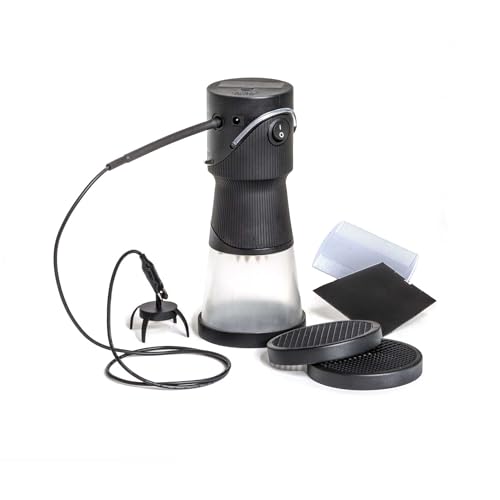
Woodland Scenics Static King
$82.01An electrostatic applicator charges loose fibers and stands them upright as they land, the technique that reads as a real field rather than a flat green mat.
Best for: realistic grass and field texture
Check price on Amazon
Woodland Scenics Scenic Cement 16 oz
$14.26Ground foam is a dyed foam texture scattered by hand and cemented flat with an adhesive like this, with no static charge and no fibers standing up.
Best for: fixing ballast and ground cover
Check price on AmazonStatic grass and ground foam solve the same problem, bare ground between the trees and the ballast, but they produce a different result because one stands the material upright and the other does not. Static grass uses an electrostatic charge to stand loose nylon or rayon fibers on end as they land on wet adhesive, which is what a real field of grass actually looks like from a normal viewing distance. Ground foam is a dyed, spongy foam texture scattered by hand and cemented flat, and it has been the standard ground cover technique for decades because it is fast, cheap and forgiving.
Neither one is obsolete. Static grass is the technique that separates a layout built recently from one that reads as dated the moment you look closely at the ground, and it is worth the extra step for any open field, meadow or roadside verge that sits close to the viewer's eye. Ground foam remains the right choice for texture that is meant to look low and matted, for covering large background areas cheaply, and for anyone not ready to buy an applicator.
On this page
Why does static grass look so much more realistic?
Real grass does not lie flat, it stands up from the ground at a range of heights and catches light and shadow along its length. An electrostatic applicator such as the Woodland Scenics Static King charges each fiber as it is released, and the charge makes the fiber stand on end and orient itself somewhat upright as it lands in wet adhesive, the same physical principle used to flock model railroad scenery for decades in the professional model-making trade before affordable home applicators existed. Ground foam has no equivalent step: it is dyed foam grains scattered and pressed down, and it stays flat by nature no matter how it is applied.
What does static grass actually need beyond the applicator?
An applicator alone does nothing without a wet adhesive base to charge the fibers into, most commonly a spray-on adhesive like Woodland Scenics Spray-Tac Adhesive. Spray the area, apply the grass while the adhesive is still wet, let it set, then vacuum or brush off the loose fiber that did not take. Skipping the adhesive step, or letting it dry before applying grass, is the most common reason a first attempt at static grass looks patchy or falls out later. For a small area, a fence line, the base of a building, a narrow verge beside the rail, hand-pressing fiber into wet adhesive with a stiff brush can look reasonably convincing, since the eye is not comparing a small patch against a large uniform field the way it would across an open meadow.
When is ground foam still the better choice?
Ground foam wins on speed, cost and large area coverage. Covering a whole backdrop hillside or a wide background field in ground foam and Woodland Scenics Scenic Cement 16 oz takes a fraction of the time an electrostatic applicator would need for the same area, and background scenery viewed from a distance rarely needs upright fiber to read correctly. Ground foam also suits texture that genuinely should lie flat, matted meadow grass, dead leaf litter, or a dirt path with sparse low growth, where standing fiber would actually look wrong.
Static grass vs ground foam, side by side
Static grass stands fibers upright for a realistic close-up field; ground foam lies flat and covers large background areas faster and cheaper.
| Factor | Static grass | Ground foam |
|---|---|---|
| Visual result | Upright fibers, reads as a real field | Flat texture, reads as low ground cover |
| Tool needed | Electrostatic applicator | None, hand scattered |
| Speed for a large area | Slower | Faster |
| Best distance from viewer | Foreground and mid-ground | Background and large fields |
| Typical cost to start | Higher, one time applicator cost | Lower, no special tool |
Can static grass and ground foam be combined on the same layout?
Yes, and most experienced scenery builders do exactly that. Ground foam covers the bulk of a scene cheaply and quickly, and static grass is reserved for the foreground areas closest to the viewer's normal eye line, where the extra realism actually gets noticed. Applying both to the same patch of ground, ground foam as a base texture with static grass tufts added on top, is a common way to add variety without redoing an entire scene. See best static grass applicators and best scenery supplies for the fuller product lineup on both sides of this comparison.
Sources
- Woodland Scenics published product specifications
Frequently asked questions
Is static grass worth it for a beginner layout?
It is worth it for any foreground area a viewer will look at closely, since standing fiber is the single biggest visual upgrade available in ground cover. It is not required to finish a first layout, and ground foam is a perfectly reasonable way to get the whole scene covered before circling back to add static grass later.
Why did my static grass fall out after it dried?
Almost always because the adhesive dried before the grass was applied, or too little adhesive was used to begin with. Static grass needs to land in wet adhesive while the electrostatic charge is still holding it upright, and working in small sections keeps the adhesive wet long enough to get the grass down properly.
Can I apply static grass without an electrostatic applicator?
You can hand-press loose fiber into wet adhesive with a stiff brush, and it looks reasonable for a small patch like a fence line or a building foundation. Across a large open field the lack of a static charge shows clearly, since hand pressing cannot orient every fiber upright the way an applicator does.
Does ground foam need a different adhesive than static grass?
Both can be set with a similar wet adhesive such as Scenic Cement, sprayed or dripped on after the loose material is scattered. Static grass additionally needs the fibers to land in the adhesive while it is wet and while the applicator is actively charging them, which ground foam does not require.
What is the difference between ground foam and turf?
"Ground foam" and "turf" are largely the same category of dyed, spongy foam texture sold in different particle sizes and blends by different manufacturers. Both lie flat once applied, and the distinction between the two names matters far less than matching the color and coarseness to the scene being modeled.
Does static grass work the same way in every scale?
Yes, the technique itself is not scale specific, since it is the fiber length and density that should change with scale rather than the applicator method. Shorter, finer fiber suits N scale, and taller fiber can suit HO and larger scales where individual blades of grass are more visible up close.
Researched, not professional advice. This page is compiled from published manufacturer specifications, instruction manuals, published NMRA standards and recommended practices, and owner-review consensus, not hands-on testing. Figures described as a rule of thumb are hobby convention rather than a standard, and they are labelled that way wherever they appear. Always check a radius, a clearance or a grade against your own equipment before you cut wood or lay rail, because manufacturers vary and so does what your specific models will tolerate. Any permanent mains wiring in a layout room is work for a licensed electrician to your local code.