HO diesel locomotives
Athearn HO SD40 Santa Fe Locomotive Review
Quick answer
The Athearn HO SD40 Santa Fe Locomotive at $169.99 is a well-detailed HO Santa Fe SD40 body shell, but the manufacturer's own listing does not describe it as sound-equipped, so anyone running a DCC sound layout should plan on a separate decoder purchase before it can match locomotives that ship sound-ready.
The Athearn HO SD40 Santa Fe Locomotive sits in Athearn's Ready-to-Run HO diesel line, prized for accurate paint schemes and printing rather than for onboard electronics. Buyers coming from a Bachmann sound-equipped starter set locomotive are sometimes surprised that this SD40 does not include a factory sound decoder, because the listing itself never claims one.
That is not a defect. It is a different product category, and this review treats the locomotive on those terms: a run-quality HO diesel body for owners who either run DC, or who plan to add their own decoder of choice.
On this page
What comes in the box
The Athearn HO SD40 Santa Fe Locomotive ships as a complete, ready-to-run HO scale model, decorated for Santa Fe. Athearn's published specifications for this RTR line describe injection-molded detail parts, blackened metal wheels, and body-mounted or truck-mounted knuckle couplers depending on the production run, which is worth confirming against the current listing since Athearn has changed coupler mounting across reissues of the same tooling.
What the listing does not describe is a factory-installed sound decoder. Compare that directly against the Bachmann SD40-2 DCC Sound Locomotive Union Pacific HO Scale, which is explicitly marketed as a DCC sound locomotive, and the difference in scope becomes clear before money changes hands.
Minimum radius and where it actually runs well
An SD40 is a six-axle, long-wheelbase prototype, and six-axle diesels are consistently the locomotives that expose an undersized curve on a first layout. Rather than repeat a generic rule of thumb here, run the exact wheelbase through the minimum radius calculator and compare the result against the manufacturer's own stated minimum, since NMRA RP-11 governs the standard and a manufacturer's number always wins when it is more conservative than the rule of thumb.
What this locomotive costs you that the price tag does not show
The honest weakness of the Athearn HO SD40 Santa Fe Locomotive is not the model itself, it is what buying it commits a DCC layout owner to next. A locomotive with no factory decoder costs you a separate purchase and a separate installation step before it can run on a DCC layout at all, and a sound-equipped one costs more again. Compare the ESU LokPilot 5 DCC Decoder 8-pin NEM652 for a non-sound decoder against the NCE D13W DCC Decoder 4 Function Universal Hard-Wire HO Scale for a hard-wire alternative, and price either one into the total before comparing this locomotive's sticker price against a sound-equipped competitor.
Alternatives if sound or DCC readiness matters more than paint
Step up: the Athearn HO GP40-2L with DCC and Sound Guilford Maine Central ships with DCC and sound already installed, at a higher price that reflects the electronics rather than the body shell.
Alternative in the Santa Fe roster, DCC sound included: the Bachmann SD40-2 DCC Sound Locomotive Union Pacific HO Scale, which trades some of Athearn's paint sharpness for a locomotive that runs on a DCC sound layout out of the box.
Budget pick: if a plain DC-only locomotive to switch cars around a small yard is the goal, this SD40 undercuts most sound-equipped six-axle diesels on price precisely because it skips the electronics. The full DCC sound versus DCC-ready comparison and the Bachmann versus Athearn comparison both cover this tradeoff in more depth.
HO diesels compared side by side
Published specifications for the SD40 and the locomotives most often cross-shopped against it.
| Model | Price | Scale | Proportion | Wheel arrangement | DCC | Onboard sound |
|---|---|---|---|---|---|---|
 Athearn HO SD40 Santa Fe Locomotive Athearn HO SD40 Santa Fe Locomotive | $169.99 | HO | 1:87 | C-C | - | - |
 Bachmann SD40-2 DCC Sound Locomotive Union Pacific HO Scale Bachmann SD40-2 DCC Sound Locomotive Union Pacific HO Scale | $215.81 | HO | 1:87 | C-C | Yes | Yes |
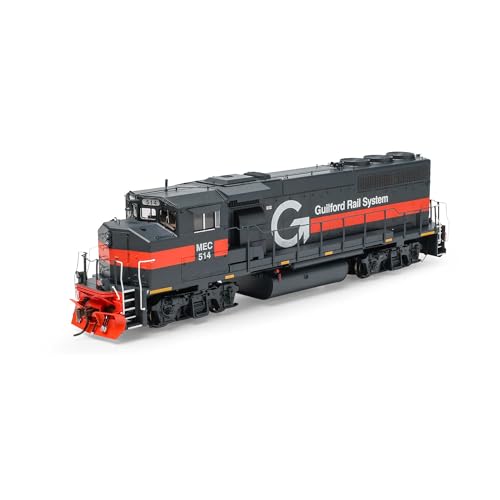 Athearn HO GP40-2L with DCC and Sound Guilford Maine Central Athearn HO GP40-2L with DCC and Sound Guilford Maine Central | $298.77 | HO | 1:87 | B-B | Yes | Yes |
 Bachmann EMD GP40 DCC Sound Equipped Locomotive Union Pacific HO Scale Bachmann EMD GP40 DCC Sound Equipped Locomotive Union Pacific HO Scale | $227.82 | HO | 1:87 | B-B | Yes | Yes |
How we chose
We did not test these products in person and we never claim to. Picks are researched from manufacturer specification sheets and instruction manuals, published NMRA standards and recommended practices, and the recurring themes in verified owner reviews. Every pick is matched to a real scale, a real minimum radius or a real current draw rather than to a price bracket, and it is placed in the tier where its capability actually belongs. Where a product is wrong for most layouts we say so on the page, and where a figure is a hobby rule of thumb rather than a published standard we say that too.
Sources
- Athearn Ready-to-Run HO diesel published product specifications
- NMRA RP-11 minimum radius recommended practice
- The consensus of verified owner reviews on Athearn RTR decoder installation
Frequently asked questions
Does the Athearn SD40 Santa Fe come with DCC and sound?
The manufacturer's published listing for the Athearn HO SD40 Santa Fe Locomotive does not describe a factory DCC sound decoder. Buyers wanting sound out of the box should compare a locomotive explicitly marketed that way, like the Bachmann SD40-2 DCC Sound Locomotive Union Pacific HO Scale, rather than assume this model includes it and be surprised at unboxing.
What minimum radius does an SD40 need in HO scale?
A six-axle diesel like the SD40 needs a wider curve than a short switcher, and the exact number depends on the specific model's wheelbase and any body overhang. Run it through the minimum radius calculator and always defer to the manufacturer's own stated minimum where one is published.
Can I add a sound decoder to the Athearn SD40 myself?
Most Athearn RTR diesels are designed to accept an aftermarket decoder, though the exact socket type varies by production run and should be confirmed against the current listing or instruction sheet before buying one. The ESU LokSound V5 8 Pin DCC Sound Decoder with Sugar Cube Speaker and ESU LokPilot 5 DCC Decoder 8-pin NEM652 are common choices for HO diesels of this size.
How does the Athearn SD40 compare to the Bachmann SD40-2?
They are different scopes of product: the Athearn HO SD40 Santa Fe Locomotive focuses on paint and body detail without a factory decoder, while the Bachmann SD40-2 DCC Sound Locomotive Union Pacific HO Scale ships with DCC sound installed. The full Bachmann versus Athearn comparison covers detail level, price and electronics side by side.
Is a DC-only locomotive still worth buying on a DCC layout?
Only as a stopgap. A DC-only locomotive placed on a DCC-powered layout without a decoder installed will not respond to a throttle correctly, and manufacturers do not recommend running it that way long-term. Budget for a decoder purchase alongside the locomotive rather than after the fact.
What couplers does the Athearn SD40 use?
Athearn RTR locomotives commonly ship with knuckle-style couplers, but the exact mounting and compatibility with Kadee-style couplers has varied across reissues of the same tooling. Check the current listing's stated coupler type before assuming compatibility with an existing fleet of freight cars.
Researched, not professional advice. This page is compiled from published manufacturer specifications, instruction manuals, published NMRA standards and recommended practices, and owner-review consensus, not hands-on testing. Figures described as a rule of thumb are hobby convention rather than a standard, and they are labelled that way wherever they appear. Always check a radius, a clearance or a grade against your own equipment before you cut wood or lay rail, because manufacturers vary and so does what your specific models will tolerate. Any permanent mains wiring in a layout room is work for a licensed electrician to your local code.