Turntables
Bachmann DCC-Equipped Motorized Turntable Review
Quick answer
The Bachmann DCC-Equipped Motorized Electric Turntable HO Scale at $236.18 is a DCC-controllable motorized turntable that only pays for itself on a layout with an actual engine terminal or roundhouse scene, since on a simple oval or point-to-point layout it functions as scenery rather than as operation.
The Bachmann DCC-Equipped Motorized Electric Turntable HO Scale is built to turn locomotives around under DCC control, indexing to different track positions the way a real engine terminal turntable does. That is a genuinely useful piece of operating equipment on the right layout, and genuinely unnecessary furniture on the wrong one.
This review focuses on that distinction, since it decides whether the turntable is worth the price more than any spec sheet does.
On this page
What the DCC turntable actually does
Bachmann's published specifications describe the Bachmann DCC-Equipped Motorized Electric Turntable HO Scale as a motorized, DCC-equipped HO scale turntable that indexes its bridge track to align with surrounding stub tracks, letting an operator turn or redirect a locomotive from a throttle rather than by hand. That is meaningfully different from a manual turntable, which requires physically walking over and rotating the bridge by hand each time.
The limitation every turntable shares
The honest limitation of any turntable, DCC or manual, is that it is a single-purpose piece of equipment: it turns locomotives, and that is the whole job. On a layout without a roundhouse, engine terminal or reason to reverse locomotives regularly, a turntable becomes scenery rather than operation, and the Bachmann DCC-Equipped Motorized Electric Turntable HO Scale's DCC control adds cost for a feature that never gets used. The turntable versus wye comparison covers the cheaper, simpler alternative for a layout that just needs to reverse a train's direction without a display-worthy engine terminal scene.
Alternatives depending on the scene
Step up for a bigger prototype scene: the Walthers Cornerstone Motorized 110 foot Turntable with DCC HO Scale models a full 110 foot turntable with DCC control, sized for larger steam and diesel power than Bachmann's HO unit.
Budget pick: the Atlas Model 305 Turntable Manual Nickel Silver HO skips DCC control entirely for a lower price, which is the right call if hand-cranking the bridge occasionally is acceptable.
Instead of a turntable: a simple wye track arrangement reverses a locomotive's direction using ordinary turnouts and track, at a fraction of the cost, if turning locomotives rather than displaying an engine terminal scene is the actual goal.
What a working engine terminal scene needs beyond the turntable itself
A turntable alone does not make an engine terminal scene look right. Most layouts that use one pair it with a roundhouse or service track structure kit, ash pit and coaling detail, and enough benchwork depth to fit the surrounding stub tracks without cramping the scene. Before buying the Bachmann DCC-Equipped Motorized Electric Turntable HO Scale, sketch the full engine terminal footprint, not just the turntable's own diameter, since the surrounding stub tracks and structures usually take up more benchwork space than the turntable itself does.
Turntables compared side by side
Published specifications for this turntable against the other options on the site.
| Model | Price | Scale | DCC |
|---|---|---|---|
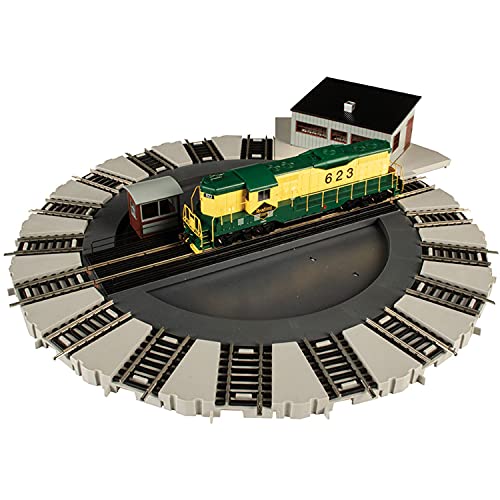 Bachmann DCC-Equipped Motorized Electric Turntable HO Scale Bachmann DCC-Equipped Motorized Electric Turntable HO Scale | $236.18 | HO | Yes |
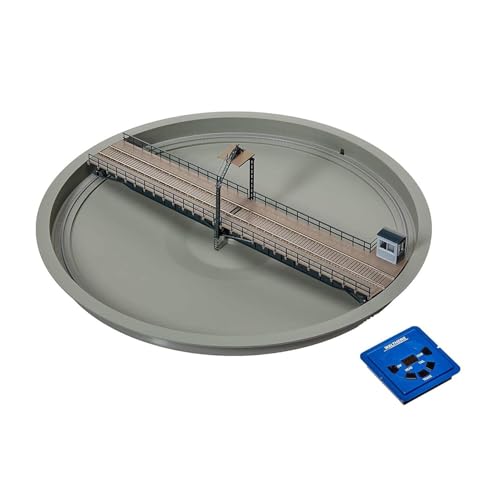 Walthers Cornerstone Motorized 110 foot Turntable with DCC HO Scale Walthers Cornerstone Motorized 110 foot Turntable with DCC HO Scale | $334.00 | HO | Yes |
 Atlas Model 305 Turntable Manual Nickel Silver HO Atlas Model 305 Turntable Manual Nickel Silver HO | $51.22 | HO | - |
 Walthers Cornerstone 90 foot Turntable HO Scale Structure Kit Walthers Cornerstone 90 foot Turntable HO Scale Structure Kit | $64.98 | HO | - |
How we chose
We did not test these products in person and we never claim to. Picks are researched from manufacturer specification sheets and instruction manuals, published NMRA standards and recommended practices, and the recurring themes in verified owner reviews. Every pick is matched to a real scale, a real minimum radius or a real current draw rather than to a price bracket, and it is placed in the tier where its capability actually belongs. Where a product is wrong for most layouts we say so on the page, and where a figure is a hobby rule of thumb rather than a published standard we say that too.
Sources
- Bachmann DCC-equipped turntable published product specifications
- The consensus of verified owner reviews on turntable indexing and reliability
Frequently asked questions
Is a DCC turntable worth it over a manual one?
Only if the turntable is operated often enough that walking over to hand-crank a manual bridge becomes a real annoyance, or if DCC-controlled operation is part of the appeal of the scene itself. For occasional use, the manual Atlas Model 305 Turntable Manual Nickel Silver HO does the same job for less money.
Do I need a turntable at all?
Only if the layout includes a roundhouse or engine terminal scene, or a reason to turn locomotives around regularly. On a simple oval or point-to-point layout, the turntable versus wye comparison shows that a plain wye of ordinary track and turnouts reverses direction for far less money.
What locomotives fit on the Bachmann DCC turntable?
That depends on the bridge track length stated in Bachmann's current published specifications relative to the specific locomotive's overall length. Always check the manufacturer's stated bridge length against the locomotives planned for the roundhouse scene before buying, rather than assume a universal fit.
How does DCC control the turntable's indexing?
The manufacturer's published specifications describe the turntable responding to DCC commands to rotate and index its bridge track to align with the surrounding stub tracks, the same way a DCC decoder controls a locomotive, rather than requiring the bridge to be positioned by hand.
Is a bigger turntable always better?
No. A bigger turntable like the Walthers Cornerstone Motorized 110 foot Turntable with DCC HO Scale suits larger prototype power and bigger engine terminal scenes, but it also takes more benchwork space and costs more. Match the turntable size to the actual locomotives and available space rather than buying the largest one available.
Can a turntable replace a reversing loop?
It can serve a similar practical purpose of turning a train around, but the two are different pieces of track and different wiring problems. A reversing loop needs a specific wiring approach the turntable versus wye comparison and dedicated wiring guides both address in more depth.
Researched, not professional advice. This page is compiled from published manufacturer specifications, instruction manuals, published NMRA standards and recommended practices, and owner-review consensus, not hands-on testing. Figures described as a rule of thumb are hobby convention rather than a standard, and they are labelled that way wherever they appear. Always check a radius, a clearance or a grade against your own equipment before you cut wood or lay rail, because manufacturers vary and so does what your specific models will tolerate. Any permanent mains wiring in a layout room is work for a licensed electrician to your local code.