Scenery
Best Model Railroad Trees
Quick answer
The best model railroad trees for a convincing forest scene are Woodland Scenics Ready Made Trees at $39.09. Mixed heights and mixed greens matter more than the detail on any single tree, and a ready-made set already varies both, which a uniform batch of identical kits does not.
A forest of identical trees, all the same height and the same shade of green, reads as artificial no matter how detailed each individual tree is. That is the biggest lesson in model railroad trees: the eye notices repetition, in a scene, far faster than it notices the sculpting on any one tree. Ready Made Trees solve this immediately for a modeler who wants a convincing forest without hand-building each one, since the set already includes a range of heights and colors in fourteen trees.
Kit-built trees, like the 5 to 7 inch tree kit and the 6 to 8 inch pine kit, take more time but let a modeler control exactly how many of each height and species end up in a scene, which matters for a large forest where buying enough ready-made sets gets expensive. Mixing at least two kits of different heights or species, rather than building an entire hillside from one box, is the habit that separates a convincing tree line from an obviously repeated one.
On this page
- Why do mixed heights matter more than tree detail?
- Should I mix deciduous and conifer trees in the same scene?
- How do trees get attached permanently to a layout?
- Best model railroad trees for a fast, convincing forest
- Best model railroad tree kits for a mixed forest
- Best model railroad tree approach for a large custom hillside
Why do mixed heights matter more than tree detail?
Real forests are made of trees at every stage of growth, and a scene built entirely from trees of one height looks like a tree farm rather than a wild treeline, regardless of how well each individual tree is sculpted. Mixing at least two height ranges, such as the 3 to 5 inch and 5 to 7 inch kits, breaks up the uniform silhouette a single-height batch creates when viewed from a normal eye-level viewing angle rather than from directly above. This one change does more for realism than upgrading the detail level of any individual tree, which is why it is worth doing before spending extra time on trunk texture or individual leaf clusters.
Should I mix deciduous and conifer trees in the same scene?
In most real-world regions, yes, since pure single-species forests are the exception rather than the rule outside of specific commercial timber stands. Mixing the conifer pine pack in among deciduous tree kits produces a more convincing woodland edge than an all-deciduous or all-conifer treeline, and it also gives a modeler more flexibility with color, since conifers stay a consistent dark green year-round while deciduous trees can be finished in green, fall color, or bare branches depending on the layout's season. Bachmann's pine tree pack is a lower-cost way to add conifer variety to a scene without committing to a full conifer-only hillside.
Ready-made trees trade some control over exact placement for speed, while kits and armatures trade speed for full control over height, species and color mix.
Ready-made trees are the fastest path to a mixed, convincing forest, while armatures give full control for a modeler willing to build each tree by hand.
| Product | Price | Format | Best for |
|---|---|---|---|
| Woodland Scenics Ready Made Tree Value Fall Colors Set of 14 | $39.09 | 14 ready-made trees | Fast, already mixed height and color |
| Woodland Scenics Tree Kits 3 to 5 inch | $23.59 | Kit, 3 to 5 inch | Foreground and smaller understory trees |
| Woodland Scenics Tree Kits 5 to 7 inch | $23.55 | Kit, 5 to 7 inch | Mid-height deciduous forest trees |
| Woodland Scenics Pine Tree Kits 6 to 8 inch | $22.39 | Kit, 6 to 8 inch | Taller pine and conifer variety |
| Woodland Scenics TR1581 Conifer Pine Trees 4 to 6 inch 24 Pack | $38.24 | 24 pack, 4 to 6 inch | Bulk conifer stands and tree lines |
| Woodland Scenics Deciduous Tree Armatures 3 to 5 inch | $16.35 | Bare armatures, 3 to 5 inch | Full custom control of shape and foliage |
Bachmann Scene Scapes pine trees are a lower-cost option for adding conifer variety in smaller quantities.
How do trees get attached permanently to a layout?
Most model trees are planted by drilling a small hole into the terrain surface at the trunk's final location, dipping the trunk end in glue, and pressing it into the hole so it stands upright and can be adjusted slightly before the glue sets. Planning tree locations before the ground cover goes down is worth the extra step, since drilling through finished ballast, static grass or ground foam later tends to disturb the surrounding texture and leave a visible disturbed patch around the new hole. On a foam-based terrain base, a simple pilot hole from an awl or a small drill bit is usually enough, while a hardshell plaster surface may need a slightly larger hole to seat the trunk securely without it working loose over time. Spacing also matters as much as the planting method: real forests rarely space trees at a uniform interval, and clustering trees into small, irregular groups with gaps between clusters, rather than distributing them evenly across a scene in a grid-like pattern, reads as far more natural once ground cover fills the spaces between the groups.
Best model railroad trees for a fast, convincing forest
Ready-made trees skip the kit-building step entirely and already vary height and color, which is the hardest part to get right by hand as a beginner.
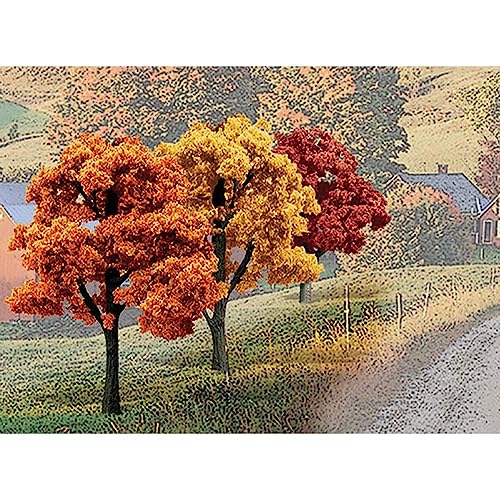
Woodland Scenics Ready Made Tree Value Fall Colors Set of 14
$39.09Fourteen trees with height and color already varied, producing a convincing scene without any assembly.
Best for: A fast forest scene with no kit-building step
Check price on AmazonBest model railroad tree kits for a mixed forest
Combining a deciduous kit with a pine kit is the simplest way to add both height variety and species variety to a growing scene.
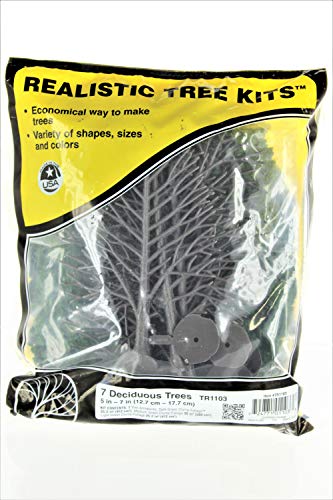
Woodland Scenics Tree Kits 5 to 7 inch
$23.55A mid-height deciduous tree kit that fills out a scene alongside taller conifers or shorter foreground trees.
Best for: The bulk of a mixed deciduous forest
Check price on Amazon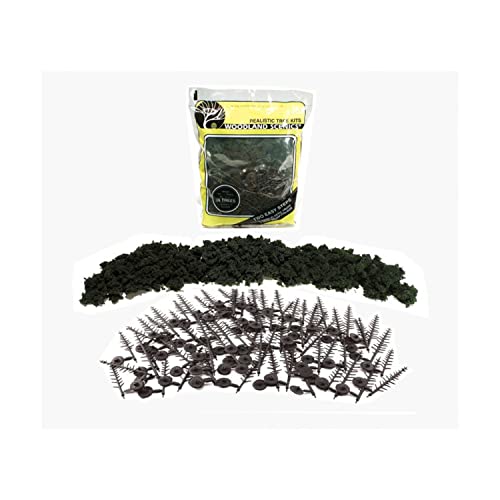
Woodland Scenics Pine Tree Kits 6 to 8 inch
$22.39Taller pine trees that break up an all-deciduous scene and add species variety along with height variety.
Best for: Mixing conifers into a deciduous tree line
Check price on AmazonBest model railroad tree approach for a large custom hillside
Building from bare armatures gives full control over exactly how many of each height, shape and foliage color end up in a large scene.

Woodland Scenics Deciduous Tree Armatures 3 to 5 inch
$16.35Bare tree armatures that let a modeler apply exactly the foliage color and density each individual tree needs.
Best for: A large hillside where full control over the final mix matters
Check price on Amazon
Woodland Scenics TR1581 Conifer Pine Trees 4 to 6 inch 24 Pack
$38.24A 24 pack of conifers priced for filling a large hillside with consistent, bulk conifer coverage.
Best for: Dense conifer stands across a large scene
Check price on AmazonWho should not buy this tier: Skip building from bare armatures if the scene only needs a handful of trees or the goal is a fast result. Ready-made trees get most of the visual benefit for a fraction of the build time on a small scene, and the armature approach only pays off once a project is large enough to justify the extra hours at the workbench.
How we chose
We did not test these products in person and we never claim to. Picks are researched from manufacturer specification sheets and instruction manuals, published NMRA standards and recommended practices, and the recurring themes in verified owner reviews. Every pick is matched to a real scale, a real minimum radius or a real current draw rather than to a price bracket, and it is placed in the tier where its capability actually belongs. Where a product is wrong for most layouts we say so on the page, and where a figure is a hobby rule of thumb rather than a published standard we say that too.
Sources
- Woodland Scenics and Bachmann published product specifications
Frequently asked questions
What matters more for realistic trees, height variety or detail?
Height and color variety across a scene matters more than the sculpting detail on any single tree. A forest built from trees of one uniform height and shade reads as artificial from a normal viewing angle, while a mixed-height, mixed-color scene looks convincing even with fairly simple individual trees.
Should I mix conifer and deciduous trees together?
In most regions, yes, since pure single-species forests are uncommon outside of managed timber stands. Mixing conifers into a deciduous scene also adds practical flexibility, since conifers hold a consistent dark green year-round while deciduous trees can be finished in green, fall color, or bare branches to match a season.
Are ready-made trees worth it compared to building tree kits?
For speed, yes. Ready-made sets already vary height and color, which is the hardest part of a convincing forest to get right by hand. Kits cost less per tree in bulk and give more control over the exact mix, which matters more for a large scene than for a small accent grove.
How many trees does a small forest scene need?
There is no fixed number, since it depends on the scale of the scene and how dense the forest is meant to look, but a common approach is to plan density first on paper or in a mockup, then buy enough trees across at least two height ranges to fill that footprint without obvious gaps.
Do model railroad trees need to be painted or altered out of the box?
Most kits and ready-made trees are usable as-is, though many modelers add extra foliage clusters, a trunk color touch-up, or ground cover around the base to blend the tree into the surrounding scenery rather than leaving it looking like a separate object placed on top.
What is the cheapest way to add a lot of trees to a large layout?
Bulk conifer packs and tree armature kits are generally the lowest cost per tree for a large hillside, since a modeler applies foliage in bulk rather than paying for a finished, ready-made tree each time. The tradeoff is build time, which scales with the number of trees needed.
Researched, not professional advice. This page is compiled from published manufacturer specifications, instruction manuals, published NMRA standards and recommended practices, and owner-review consensus, not hands-on testing. Figures described as a rule of thumb are hobby convention rather than a standard, and they are labelled that way wherever they appear. Always check a radius, a clearance or a grade against your own equipment before you cut wood or lay rail, because manufacturers vary and so does what your specific models will tolerate. Any permanent mains wiring in a layout room is work for a licensed electrician to your local code.